How Long Should an AC Take to Cool 1 Degree? Why There Is No Single Number
| Written by | Ask About HVAC Editorial Team | Expert review | Pending |
|---|---|---|---|
| Published | Last updated | ||
| Sources | 6 cited | Reading time | 4 min |
Quick answer
There is no industry standard for how many minutes an air conditioner should take to lower your home by 1 degree. The rate depends on how big your system is compared with how much heat is coming into the house at that moment, so the same healthy AC might drop a degree quickly on a mild morning and barely hold steady at 4 p.m. in a heat wave.
What you can check is whether your system behaves the way a healthy one does: steady runs that make progress in normal weather, cool air from the vents, and no short on-off bursts. The test further down takes an hour and a notepad.
Why other sites give you numbers that don't match
We compared the top search results for this question on October 18, 2026. Here is what they claim:
| Source type | Claimed time per degree | Cited a source? |
|---|---|---|
| HVAC information site | 15 to 24 minutes | No |
| Local HVAC company A | 10 to 15 minutes (room), 5 to 10 minutes (central) | No |
| Local HVAC company B | 30 to 60 minutes | No |
| HVAC technician forum | "No industry standard" | Experience, not data |
The highest estimate is about six times the lowest. None of those minute figures comes with a study or test. A forum reply from a technician made the most useful point: on a design-condition day, a correctly sized system should run almost continuously. That matches how systems are chosen, as explained below.
What sets the cooling rate
Your AC removes heat at a fairly fixed rate. Your house gains heat at a rate that changes all day. The temperature only falls by the difference between the two.
| Factor | Effect on minutes per degree |
|---|---|
| Outdoor temperature and sun on the roof | The hotter it is, the more heat leaks in, the slower the drop |
| Humidity | Part of the AC's output goes to pulling water out of the air instead of lowering temperature |
| How far you are trying to go | Pulling down a hot house after a day off takes far longer than holding a set point |
| System size compared with the home's heat load | Undersized falls behind on hot days; oversized cools fast but short-cycles |
| Airflow (filter, coil, ducts) | ENERGY STAR says airflow problems can cut efficiency by up to 15% |
| Refrigerant charge | Too much or too little makes the system less efficient, per ENERGY STAR |
The last two come from the ENERGY STAR maintenance checklist. They are the parts a technician can fix. The first four are the reasons no single number works.
A long run is often normal; a short one often is not
Contractors are supposed to size equipment from a room-by-room load calculation (ACCA Manual J) and then pick equipment using ACCA Manual S. The Building America Solution Center explains that a system sized to its projected loads gives better temperature and humidity control, while an oversized one short-cycles: short bursts of cooling followed by long off periods.
The EPA's ENERGY STAR fact sheet on right-sized air conditioners adds three facts that matter here:
- An AC is least efficient when it first starts and reaches peak efficiency after about 10 minutes.
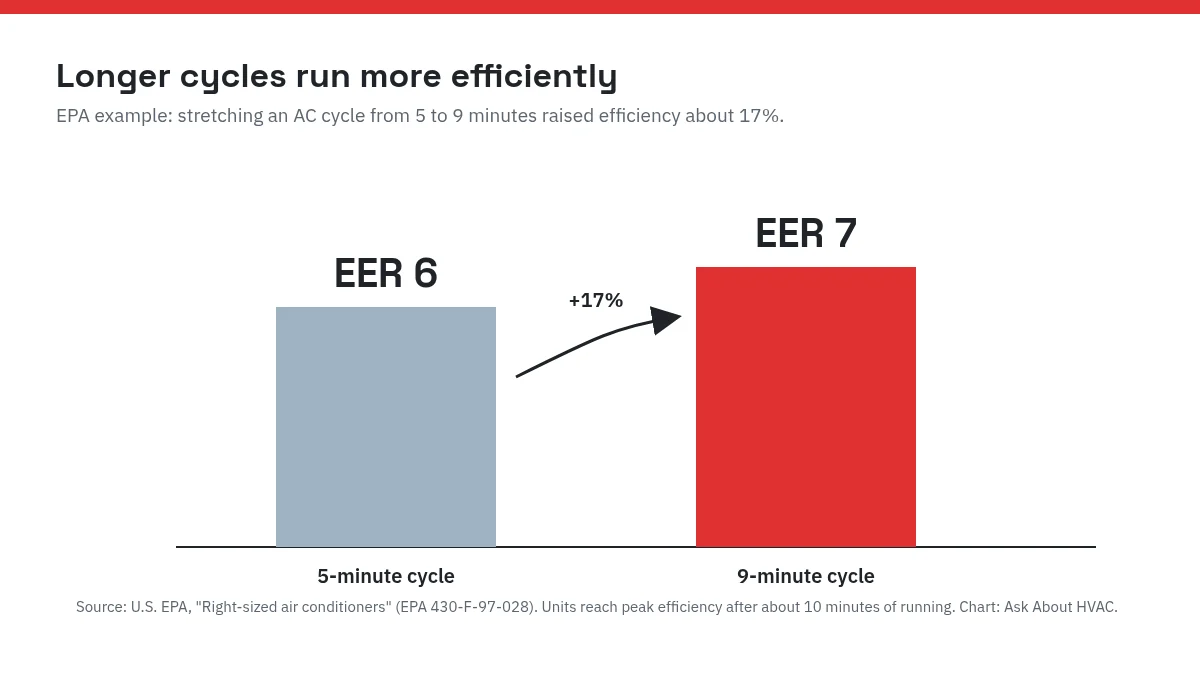
- In its example, raising run time from 5 to 9 minutes improved efficiency by 17 percent.
- Short runs do not leave time for moisture to condense on the coil and drain away, so an oversized unit can leave the house cool but clammy.
So an AC that runs for long stretches on a hot afternoon may be doing exactly what it was sized to do. One that blasts cold air for a few minutes, shuts off, and leaves the house feeling damp is the more common sizing problem. Lennox, a manufacturer, describes a normal cycle in typical weather as about 15 to 20 minutes, two to three times an hour, and says cycles run longer when it is hotter than usual.
The 1-hour test: is your AC actually too slow?
Do this in the late morning on a normal day for your area, not during a record heat wave.
- Start with a clean filter and all supply vents open.
- Note the outdoor temperature from a weather app.
- Set the thermostat 3 degrees below the current indoor temperature. Do not go lower; it will not speed anything up.
- Every 15 minutes, write down the indoor temperature on the thermostat and whether the system is running.
- Hold your hand at a supply vent near the air handler. The air should feel clearly cold, not cool.
- After an hour, compare your log with the table.
| What your log shows | What it likely means |
|---|---|
| Steady runs, temperature falling, set point reached within the hour | Normal |
| Runs nonstop, temperature falling slowly, very hot afternoon | Often normal on a design day; check again on a milder day |
| Runs nonstop, temperature flat or rising, mild day | Problem: airflow, refrigerant, or a failing part. Call a technician |
| Shuts off after a few minutes, starts again soon, house feels damp | Short-cycling. Often oversizing or a thermostat placement issue |
| Air from vents not cold, outdoor unit fan not spinning | Outdoor unit problem. Turn the AC off and call a technician |
| Ice on the copper line or coil | Airflow or refrigerant problem. Turn cooling off and let it thaw |
Write down the times and temperatures and show them to the technician. A log beats "it feels slow."
Humidity is half the story
Your AC also removes moisture. The EPA recommends keeping indoor relative humidity below 60 percent, ideally between 30 and 50 percent, and notes that an inexpensive humidity meter from a hardware store can measure it. If your house hits the set temperature fast but the meter reads above 60 percent, a slower, longer-running cycle would serve you better than a faster drop. Ask about it before you replace a system with a bigger one.
When to call a pro
- The temperature does not fall during a long run on a mild day.
- Vents blow cool rather than cold air.
- You see ice, hear grinding or buzzing, or the outdoor fan is not turning.
- The breaker trips.
Refrigerant work and electrical repairs need a licensed technician. In Texas, you can check an air conditioning contractor's license on the TDLR license search.
FAQ
Is it bad if my AC runs all day in a heat wave?
Not by itself. A system sized from a load calculation is chosen for hot design days, so on the hottest afternoons it may run almost nonstop. It is a problem if the house keeps getting warmer while it runs, or if it runs nonstop on mild days too.
Will setting the thermostat lower cool the house faster?
A typical single-speed central AC delivers the same output whether you set 72 or 65; a lower setting only makes it run longer and overshoot. Set the temperature you actually want.
How short is too short for an AC cycle?
EPA's ENERGY STAR fact sheet on sizing says an AC reaches peak efficiency after about 10 minutes of running. A system that regularly shuts off after only a few minutes is short-cycling, which is a common sign of an oversized unit.
Why does my AC cool fine in the morning but fall behind in the afternoon?
The heat load rises through the day as the sun heats the roof and walls and the outdoor temperature climbs. A slower rate after lunch is normal. Falling behind more each day, or warm air from the vents, is not.
Sources
| # | Source | Site |
|---|---|---|
| 1 | Right-Sized Air Conditioners (EPA 430-F-97-028), ENERGY STAR / U.S. EPA | energystar.gov |
| 2 | Whole-House Dehumidification, Building America Solution Center (PNNL) | basc.pnnl.gov |
| 3 | Maintenance Checklist, ENERGY STAR | energystar.gov |
| 4 | Why Your Air Conditioner Won't Turn Off, Lennox | lennox.com |
| 5 | A Brief Guide to Mold, Moisture and Your Home, U.S. EPA | epa.gov |
| 6 | Manual S Residential Equipment Selection, ACCA | acca.org |
Every number above was checked against these sources. Found an error? See corrections or email contact@askabouthvac.com.
Expert review status: pending
The editorial fact-check of this guide is complete. It is queued for review by J.T. Bratcher, a Texas-licensed air conditioning contractor. His name and the review date will appear here and at the top of the page only after he approves it.
Related answers
- Ac · Air Conditioning
Water Dripping From Your Furnace in Summer? It's Usually the AC Drain
Water under a furnace in summer almost always comes from the AC coil sitting on top of it, not the furnace. A 2-minute check to find the source, a cause table, and safe fixes.
- Th · Thermostats
Should Your AC Fan Be On or Auto? What the Humidity Research Shows
In humid climates, keep the AC fan on Auto: measured tests show fan On puts water from the coil back into your air. When On or Circulate makes sense, and a simple test for your home.