Should Your AC Fan Be On or Auto? What the Humidity Research Shows
| Written by | Ask About HVAC Editorial Team | Expert review | Pending |
|---|---|---|---|
| Published | Last updated | ||
| Sources | 7 cited | Reading time | 3 min |
Quick answer
Set the fan to Auto during cooling season if you live anywhere humid. When the fan keeps running after the compressor shuts off, it blows across a wet coil and puts that water back into your house. Lab and field measurements from the Florida Solar Energy Center show the effect clearly. In dry climates, or in heating season when the coil is dry, running the fan On costs electricity but does not raise humidity the same way.
What actually happens when the fan stays on
During a cooling run, water condenses on the indoor coil and drips into the drain pan. With the fan on Auto, the fan stops with the compressor and most of that water drains away. With the fan on On, air keeps flowing over the wet coil and pan.
Researchers at the Florida Solar Energy Center measured this on two systems (Khattar, Swami and Ramanan, FSEC-PF-118-87, published in ASHRAE Transactions):
| Test | Result with fan On |
|---|---|
| 20-minute cycle: compressor on 10 min, fan running the whole time | 19% of the water condensed during the on-cycle evaporated back into the room |
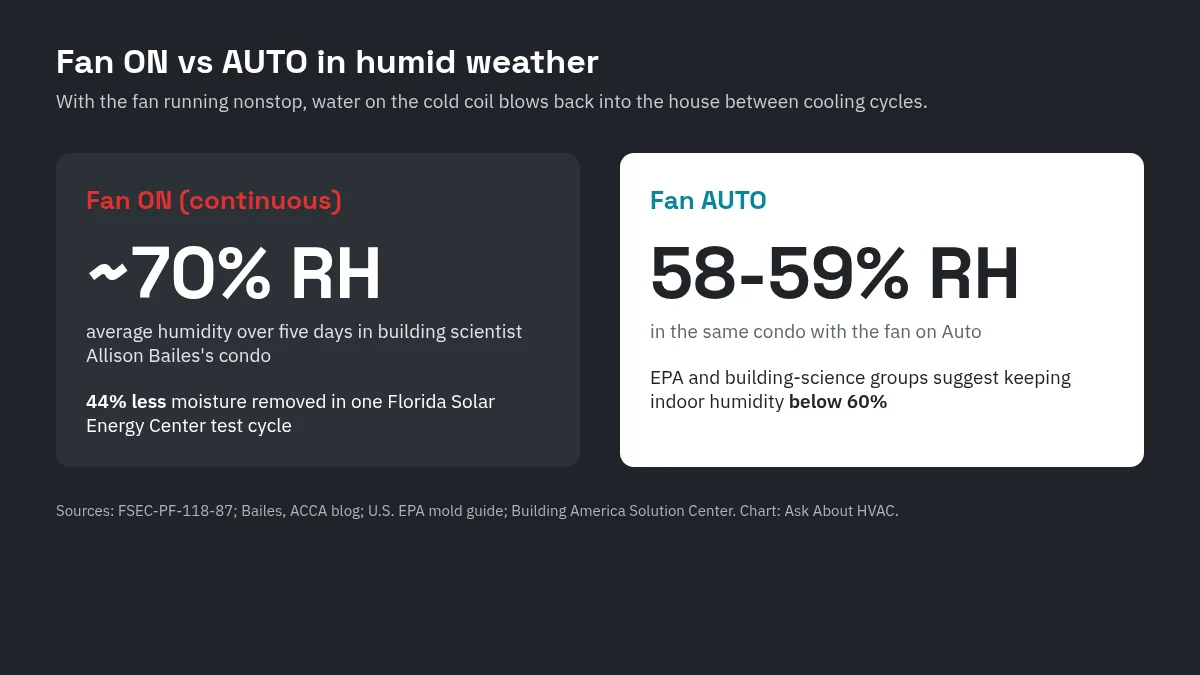
| 10-minute cycle with 5 minutes of compressor time | Moisture removal was 44% lower than with fan Auto |
| Indoor humidity | Higher with fan On than with fan Auto |
The authors also found that the re-evaporation rate grew as the number of cycles increased, and they concluded that cycling the compressor and fan together gives better dehumidification. For extra air movement they suggested ceiling or paddle fans instead. A later ASHRAE Journal article by FSEC researchers confirmed that a coil's moisture removal degrades at part load, especially when the supply fan runs continuously.
A real-home example: building scientist Allison Bailes switched his own condo's thermostat from Auto to On for five days. Relative humidity averaged about 70% with the fan On, compared with about 58 to 59% on Auto.
Why 70% humidity matters
The EPA advises keeping indoor relative humidity below 60 percent, ideally between 30 and 50 percent, to limit mold. The Building America Solution Center gives the same 60% ceiling for homes in warm-humid climates. A setting that pushes a home from the high 50s to around 70 moves it the wrong way.
On vs Auto vs Circulate
| Auto | On | Circulate (some thermostats) | |
|---|---|---|---|
| Fan runs | Only with heating or cooling | All the time | With heating/cooling plus some minutes each hour |
| Humidity in cooling season | Best | Worst (re-evaporation) | In between, depends on minutes set |
| Electricity | Lowest | Highest; the fan also adds heat, about 2 °F to the moving air per the FSEC paper | In between |
| Air mixing between floors and rooms | Least | Most | Moderate |
| Filter run time | Least | Most | Moderate |
| Duct leaks pulling attic air | Only while running | All the time | Partly |
The duct point comes from Bailes' list of reasons: running the fan constantly increases total duct leakage, and unbalanced leakage can also pull more outside air through the house. If your ducts run through a hot attic, that is hot, humid air.
When fan On can make sense
- Dry climates. ACCA's technical expert put it as a location-specific answer: in arid climates there is little downside, while in humid "wet coil" climates, fan On generally raises indoor humidity.
- Heating season. The coil is not wet, so there is nothing to re-evaporate.
- A room that is always hotter or colder. Mixing air can even things out. Try Circulate first.
- Short-term filtration, for example during wildfire smoke, if humidity stays in range.
Test it in your own home
- Buy a humidity meter. The EPA notes they cost about $10 to $50 at hardware stores.
- Run the fan on Auto for three or four days in normal summer weather. Write down the humidity morning and evening.
- Switch to On (or Circulate) for the same number of days at the same temperature setting.
- Compare. If humidity rises toward or above 60% on the second setting, go back to Auto.
FSEC's own guidance for Florida homes is to run the supply fan in Auto mode with no fan overrun after the compressor stops (FSEC/UCF). "Fan overrun" is a delay some systems use to keep the blower going after cooling ends; if your house runs humid even on Auto, ask a technician whether that delay is set and whether your system is oversized.
FAQ
Does running the fan on cool the house?
Only a little, and only right after the compressor stops. Florida Solar Energy Center measurements found that the extra cooling comes from water evaporating off the coil, which raises indoor humidity at the same time.
Is it OK to run the fan on in winter?
The coil is dry in heating season, so the re-evaporation problem does not apply. The trade-offs are the fan's electricity use and, with leaky ducts, pulling air from attics or crawlspaces.
What does the Circulate setting do?
On thermostats that have it, Circulate runs the fan with heating or cooling and also for a set number of minutes each hour when the system is idle. It sits between Auto and On.
Will fan On make my air filter work better?
More run time pushes more air through the filter, so it can capture more particles. In a humid climate that benefit comes with higher humidity during cooling season, so weigh it against a humidity reading.
Sources
Every number above was checked against these sources. Found an error? See corrections or email contact@askabouthvac.com.
Expert review status: pending
The editorial fact-check of this guide is complete. It is queued for review by J.T. Bratcher, a Texas-licensed air conditioning contractor. His name and the review date will appear here and at the top of the page only after he approves it.
Related answers
- Ac · Air Conditioning
How Long Should an AC Take to Cool 1 Degree? Why There Is No Single Number
There is no industry standard for minutes per degree. What a normal AC run looks like in mild weather vs a heat wave, why sites disagree, and a 1-hour test to tell if yours is too slow.
- Ac · Air Conditioning
Water Dripping From Your Furnace in Summer? It's Usually the AC Drain
Water under a furnace in summer almost always comes from the AC coil sitting on top of it, not the furnace. A 2-minute check to find the source, a cause table, and safe fixes.