Water Dripping From Your Furnace in Summer? It's Usually the AC Drain
| Written by | Ask About HVAC Editorial Team | Expert review | Pending |
|---|---|---|---|
| Published | Last updated | ||
| Sources | 5 cited | Reading time | 6 min |
Quick answer
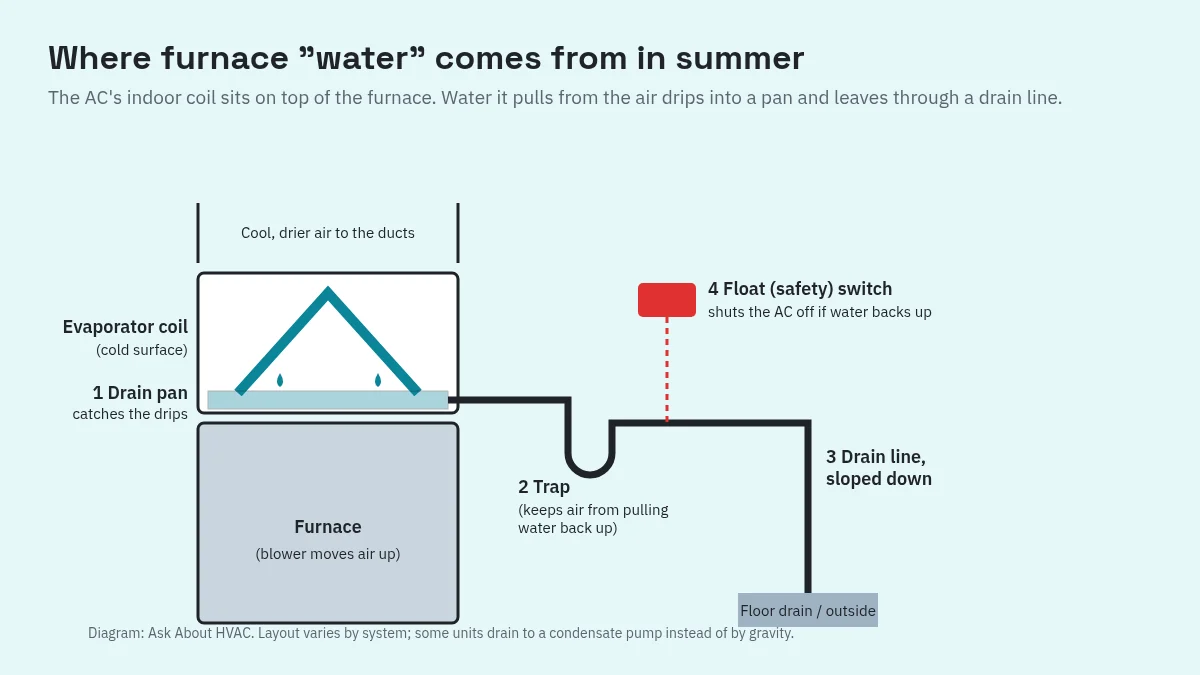
Water under your furnace in summer almost always comes from the air conditioner, not the furnace. The AC's indoor coil usually sits right on top of the furnace, and it pulls water out of the air. That water should run into a pan and out through a drain line. If the line is clogged, the pan is cracked, a condensate pump has failed, or the coil froze and is melting, the water ends up on the furnace and the floor.
Turn the cooling off at the thermostat, mop up, and use the check below to find which of those it is.
First, confirm where the water is coming from
You can sort this out in about two minutes with a flashlight. Do not open any panel that is screwed shut.
| Look here | What you see | What it points to |
|---|---|---|
| Top of the furnace, where the metal coil box sits | Water running down the outside of the cabinet, rust streaks | AC coil drain pan overflowing or leaking |
| The white or gray pipe (often 3/4 inch PVC) leaving the coil box | Water dripping from a joint, or the pipe ends at a pump that is full | Clogged drain line or failed condensate pump |
| A box mounted on the side of the furnace or ductwork with a water line | Wet pad housing, drip from its tube | Whole-house humidifier (Trane lists this as a common cause) |
| Copper line going into the coil box | Frost or ice on the pipe or coil | Frozen coil (airflow or refrigerant problem) |
| PVC vent pipes on the furnace itself | Water only when the heat runs | High-efficiency furnace condensate, a winter issue |
Trane gives a quick way to tell which furnace you have: a metal exhaust pipe means a standard furnace, while PVC pipes, usually an intake and an exhaust, mean a condensing furnace that makes its own water in heating mode. In July, with the heat off, the furnace is almost never the source.
Why an AC makes water at all
As air passes over the cold evaporator coil, its temperature drops below the point where it can hold its moisture, and the water condenses and drips into a pan under the coil. The pan then sends it to a drain line, according to the Building America Solution Center, a U.S. Department of Energy resource run by Pacific Northwest National Laboratory. On a humid day that can be a steady stream, so even a partial clog shows up fast.
The five common causes, most likely first
1. Clogged condensate drain line
The drain pan has to drain continuously or it overflows, and a stagnant pan can grow algae and bacteria, BASC notes. That slime, plus dust that falls off the coil, is what blocks most lines. ENERGY STAR's maintenance checklist tells contractors to inspect this drain at every check-up because a plugged drain can cause water damage and affect indoor humidity.
What you can do: find the drain line's cleanout (often a capped tee near the coil) or its outdoor end. With the power off, use a wet/dry vacuum on the outdoor end to pull the clog out. The Department of Energy also suggests occasionally passing a stiff wire through the unit's drain channels to prevent clogs.
2. Dry, missing or badly built trap
Most drain lines have a U-shaped trap. BASC explains that it stops air from moving through the drain. On systems where the fan pulls air across the coil, a poor trap lets air rush up the pipe, which can stop the pan from draining and make it overflow. BASC describes a typical trap as a 2-inch drop from the pan plus 2 more inches for the seal, with a removable cleanout cap. If your line has no trap at all, or it was just rebuilt and leaks started, that is a job for the installer.
3. Condensate pump failure
If your furnace is in a basement or a spot with no floor drain, the coil drains into a small pump. A float inside turns the pump on as water rises, and pumps tubing to a safe spot, BASC says. Pour a cup of water into the pump's reservoir. If the motor does not start, the pump has likely failed. If it runs but water still backs up, the discharge tube is kinked or clogged.
4. Cracked or rusted drain pan
Older systems used steel pans that pit and rust; newer ones are plastic. BASC warns that mistaking a rusted-out pan for a simple clog is costly, because replacing the pan often means replacing the coil. If the drain flows freely when you pour water in but water still drips from the bottom of the coil box, suspect the pan.
5. Frozen coil that is melting
A coil that ices over drips heavily when it thaws. Trane says a dirty coil can freeze and that a professional should handle a frozen coil. Check your filter first: a clogged filter cuts airflow over the coil. If the filter is clean and the coil keeps freezing, low refrigerant is a likely cause, and only a licensed technician can find and fix a refrigerant leak.
Step-by-step: what to do right now
- Set the thermostat to Off (not just warmer). If you see ice, set the fan to On for a few hours so the coil thaws faster, and keep towels down.
- Turn off power to the furnace at the service switch (it looks like a light switch on or near the unit) before you touch the drain or pump.
- Mop up and move anything stored near the unit. Standing water damages flooring and drywall fast.
- Check the filter. Replace it if you cannot see light through it.
- Test the drain. Pour a cup of water into the drain line cleanout or pan. It should flow out the other end or into the pump right away.
- Clear a slow line from the outdoor end with a wet/dry vacuum, then test again.
- Check any pump by filling its reservoir as described above.
- Restore power and cooling, then check the area again in an hour.
Call a licensed HVAC technician if the coil keeps freezing, the pan is cracked, water comes from inside a sealed panel, or you see water near wiring. In Texas, HVAC contractors are licensed by the Texas Department of Licensing and Regulation, and you can look up a license there before you hire.
Why your AC may have shut itself off
If cooling stopped and you found water, a safety switch probably did its job. The International Residential Code requires extra protection wherever an overflowing coil pan would damage the building, such as an attic or a furnace above finished floors. Section M1411.9.1 allows four methods:
| Method in the code | How you would notice it |
|---|---|
| Auxiliary pan under the unit with its own drain to a "conspicuous" spot | Water dripping from a pipe over a window or eave |
| Second (overflow) drain from the main pan, also to a conspicuous spot | Same: water from an odd pipe outside |
| Auxiliary pan with a water-level switch that shuts the equipment off | AC stops; water sits in the pan |
| Water-level switch in the main pan or drain line | AC stops with no visible leak |
The same section sets the drain at no less than 3/4 inch pipe, sloped at least 1/8 inch per foot. If water is coming out of a pipe above a window, that is the overflow telling you the main drain is blocked. Clear the main drain; do not cap the overflow. Local codes can differ, so ask your building department or contractor what applies to your home.
How to keep it from happening again
- Change the filter on schedule. ENERGY STAR tells homeowners to inspect, clean or change air filters once a month.
- Book the spring check-up before the first heat wave. ENERGY STAR's list for that visit includes inspecting the condensate drain and cleaning the coils.
- Flush or vacuum the drain line once early in the cooling season.
- If your unit sits above a finished ceiling and you are not sure it has a float switch or auxiliary pan, ask at the next visit.
FAQ
Is it normal for water to come out of my furnace in summer?
Water should leave through the drain line to a floor drain, pump or outdoors. Water on the floor or inside the cabinet is not normal. In summer it usually means the AC coil's drain pan or drain line is not draining.
Can I keep running the AC if it is dripping?
Turn cooling off until you find the cause. If the leak comes from a frozen coil, running it longer makes more ice and more water. If a drain is blocked, the pan keeps overflowing onto the furnace and floor.
Why did my AC shut off by itself and now there is water?
Many systems have a float switch in the drain pan, drain line or an auxiliary pan. The residential code lists it as one way to shut off the equipment before the pan overflows. When it trips, the AC stops until the water drains.
Does a standard furnace make water?
A standard-efficiency furnace with a metal vent pipe does not make condensate during heating. A high-efficiency furnace with PVC pipes does, but only when it is heating, so it is not the source of a summer leak.
Sources
Every number above was checked against these sources. Found an error? See corrections or email contact@askabouthvac.com.
Expert review status: pending
The editorial fact-check of this guide is complete. It is queued for review by J.T. Bratcher, a Texas-licensed air conditioning contractor. His name and the review date will appear here and at the top of the page only after he approves it.
Related answers
- Ac · Air Conditioning
How Long Should an AC Take to Cool 1 Degree? Why There Is No Single Number
There is no industry standard for minutes per degree. What a normal AC run looks like in mild weather vs a heat wave, why sites disagree, and a 1-hour test to tell if yours is too slow.
- Th · Thermostats
Should Your AC Fan Be On or Auto? What the Humidity Research Shows
In humid climates, keep the AC fan on Auto: measured tests show fan On puts water from the coil back into your air. When On or Circulate makes sense, and a simple test for your home.