Why Does My Furnace Filter Collapse? 5 Causes and How to Stop It
| Written by | Ask About HVAC Editorial Team | Expert review | ✓ J.T. Bratcher |
|---|---|---|---|
| Published | Last reviewed | ||
| Sources | 7 cited | Reading time | 7 min |
Quick answer
A furnace filter collapses when the air pulling through it pushes harder than its frame and pleats can hold. The most common reasons are a filter that's packed with dust, a filter that doesn't fit the slot, a thin 1-inch filter on a system that moves a lot of air, and a denser filter than the system was built for. A collapsed filter also lets air sneak around it, so replace it now with the correct size, then work out which cause applies so the next one stays flat.
The 5 causes at a glance
| What you see | Likely cause | Fix |
|---|---|---|
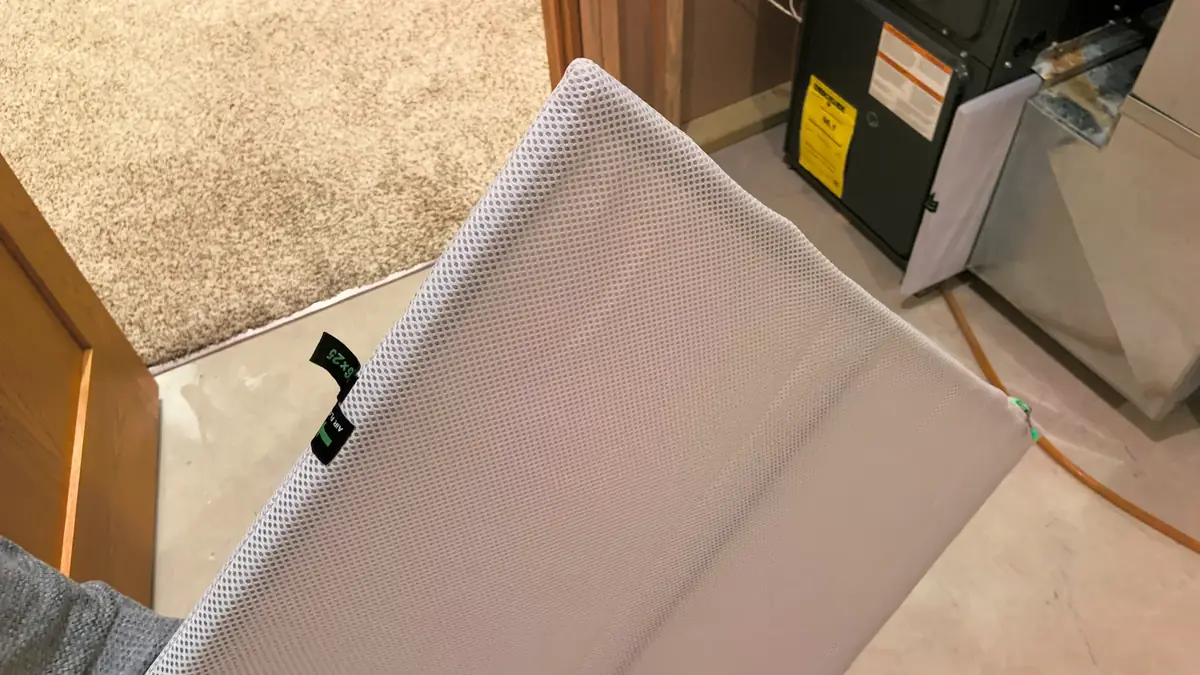
| Filter is gray and bowed toward the blower | Overdue, loaded with dust | Replace it and check monthly |
| Gaps at the edges, or the frame was bent to fit | Wrong size for the slot | Buy the size printed on the old frame or in the manual |
| New 1-inch filter bows within a few weeks | Too much air through too little filter | Ask about a thicker filter cabinet |
| Started right after a MERV upgrade | Filter denser than the system handles | Ask a technician which MERV your system takes |
| Pleats folded on the wrong side | Filter installed backwards | Turn it so the arrow points toward the furnace |
The first two are things you can fix today. The last three point to the system itself, and they usually take a technician to settle.
Why air pressure folds a filter
Every filter resists the air going through it. Filter makers publish that resistance in inches of water gauge (in. w.g.), and they also publish a "final resistance," the point where the filter should come out.
AAF's product sheet for its PerfectPleat HC M8, a MERV 8 pleated filter, shows how much that resistance depends on thickness and air speed. When clean, the 1-inch version starts at .23 in. w.g. at 300 feet per minute and .42 at 500. The 2-inch version starts at .12 and .23 at those speeds, and the 1-inch isn't rated for 625 feet per minute at all. All three thicknesses list a final resistance of 1.0 in. w.g. (AAF PerfectPleat HC M8 product sheet).
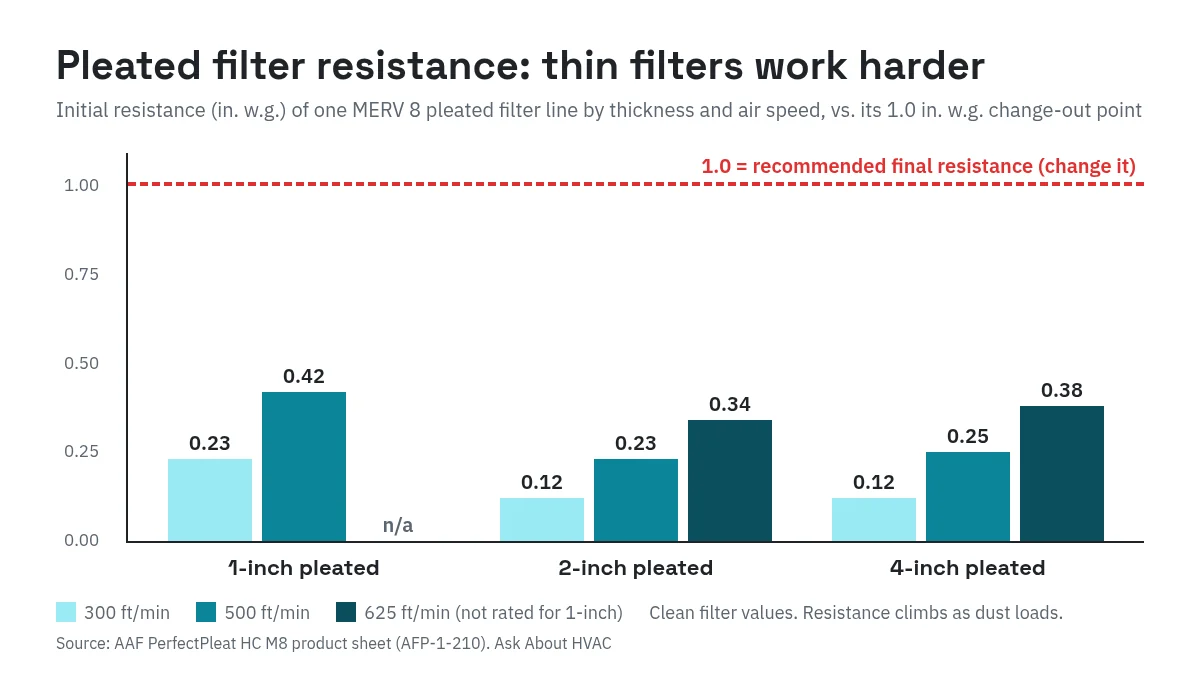
Our reading of those numbers: as a filter loads with dust, the pressure on it climbs toward that 1.0 line, and a thin filter starts closer to it. A cheap 1-inch frame with no reinforcement is the first thing to give. AAF builds three support straps into both faces of its 1-inch model to hold the pleats in place, and says its 2-inch filter "resists crushing and abuse" (AAF). Filters without that kind of support fold sooner.
1. The filter is overdue and packed with dust
This is the cause we would check first. A loaded filter blocks more air, so the blower pulls harder on it until the middle bows in.
ENERGY STAR tells homeowners to inspect, clean or change air filters once a month in a furnace, central air conditioner or heat pump. It also warns that a dirty filter can raise energy costs and damage your equipment, leading to early failure (ENERGY STAR maintenance checklist). The EPA says manufacturers typically recommend replacement every 60 to 90 days, and to follow the maker's schedule for your filter (EPA Guide to Air Cleaners in the Home).
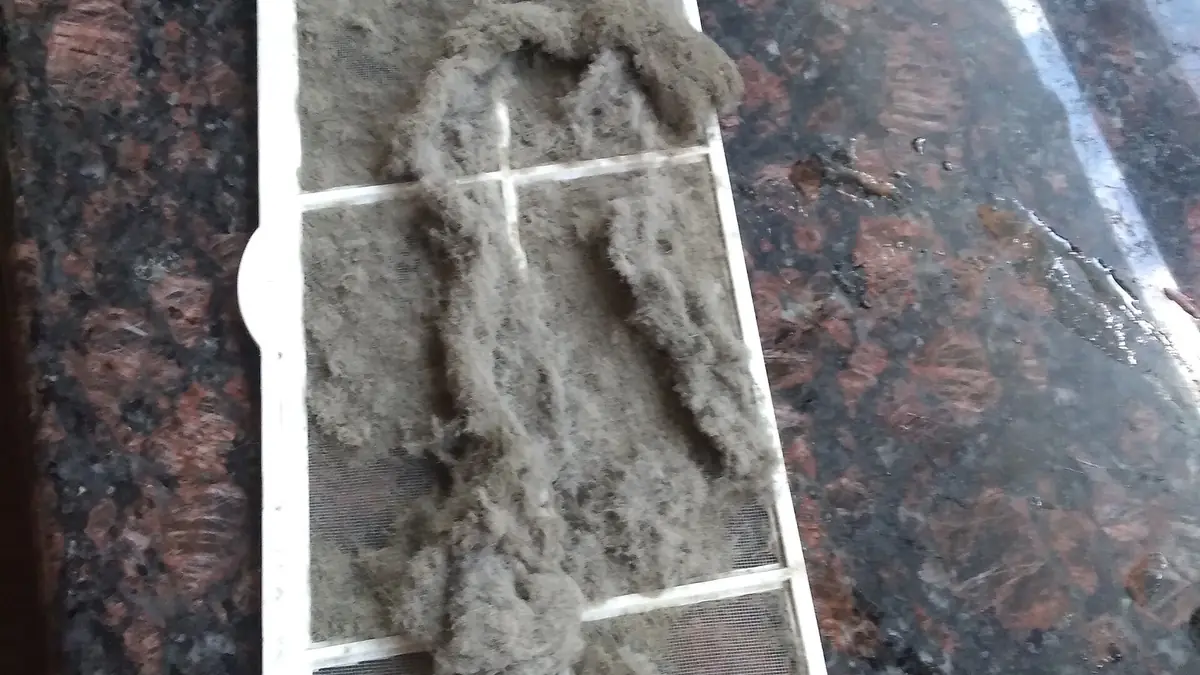
If you are not sure whether yours is due, our guide on how to tell if your furnace filter needs changing walks through the light test and the other checks.
2. The filter is the wrong size for the slot
A filter that's too small sits loose, so air hits it unevenly and it can tip or fold. A filter that's too big gets forced in and is already bent before the blower starts.
The EPA is direct about this. Filters commonly come in thicknesses of 1 to 5 inches, and the filter should fit snugly so air does not leak around it and you do not have to bend or crush it to make it fit (EPA). Trane's owner's guide says to replace a filter with the same size as the one originally supplied, and gives one of its gas furnace layouts as an example that takes a 17 x 25 x 1 inch filter (Trane Indoor Units Owner's Guide).
Read the size on the old frame. Keep in mind that the printed size is a nominal size: AAF lists a nominal 16 x 25 x 2 filter as actually measuring 15 1/2 x 24 1/2 x 1 3/4 inches (AAF). Measure the slot if the old filter was clearly wrong.
3. A thin filter on a lot of air
Some systems move a lot of air through a 1-inch slot. In the AAF numbers above, the 1-inch filter at 500 feet per minute starts at almost twice the resistance of the 2-inch at the same speed, so it has less room before it reaches the change-out point.
If a brand-new, correctly sized 1-inch filter bows within a few weeks, the slot may simply be too small for the airflow. That is our reasoning from the resistance data, not a published rule, and it's a job for a technician to confirm. Many furnaces can be fitted with a deeper filter cabinet, and the EPA notes that an HVAC technician can modify a system to use a higher efficiency filter (EPA).
4. A denser filter than the system was built for
Higher-MERV filters trap finer particles. The EPA says the higher the MERV rating, the better the filter is at trapping specific sizes of particles, and suggests at least MERV 13, or as high a rating as your system fan and filter slot can accommodate (EPA What is a MERV rating?).
The EPA also says most furnaces and HVAC systems can take a MERV 13 filter without creating equipment problems, provided the filter is replaced frequently. Because systems are not commonly labeled with filter recommendations, it suggests a professional HVAC technician confirm which filter your system can use (EPA).
So if the collapsing started right after you moved up in MERV, two things to try: change the new filter more often than the old one, and ask a technician whether your blower and slot can handle it. A deeper filter at the same MERV is often the way to keep both clean air and airflow.
5. The filter went in backwards
Trane's guide says to insert the clean filter with the arrows on it pointing in the direction of the airflow (Trane). On reinforced pleated filters, the support is placed with airflow in mind: AAF uses support straps on the air entering side and pleat stabilizers on the air leaving side of its 2-inch model (AAF). Our reasoning: flip that filter around and its pleats lose support on the side the air pushes them toward.
Our guide on which way the furnace filter arrow goes and what to do if it was in backwards shows the arrow direction for each furnace layout.
What a collapsed filter does to the furnace
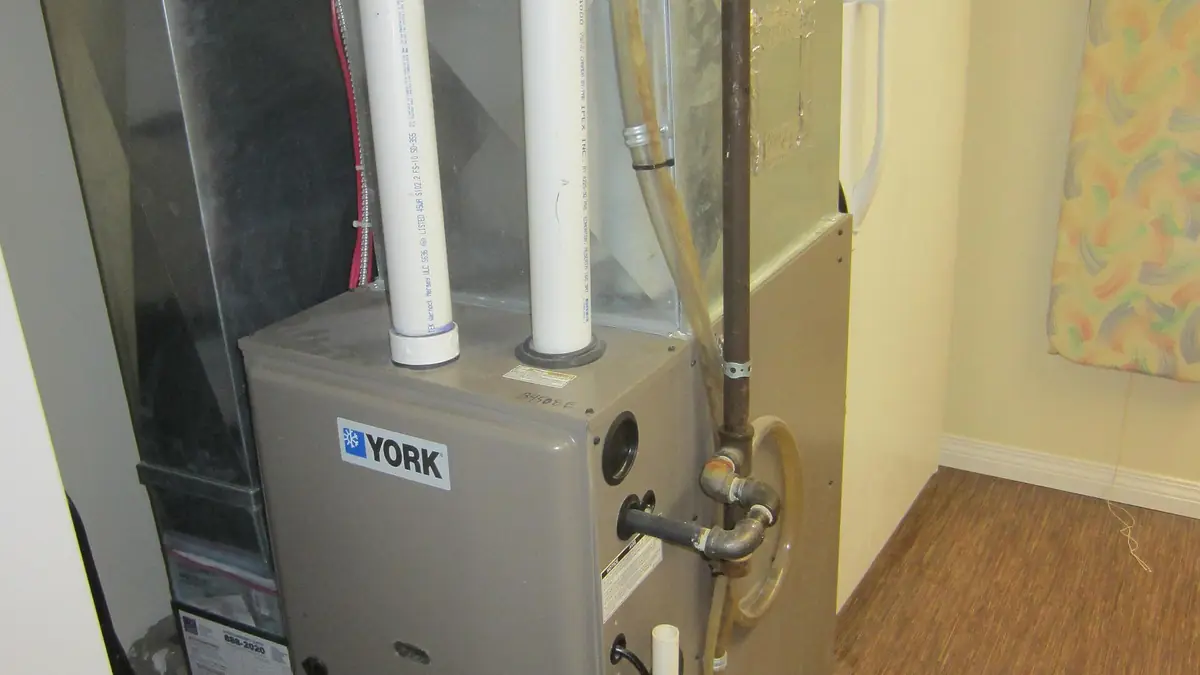
A folded filter fails two ways. Where it has pulled away from the frame, air and dust go around it and onto the blower and coil. Where it's packed tight, it chokes the airflow.
Carrier says a severely blocked filter starves the furnace of return air. Without cool air to absorb heat from the heat exchanger, the temperature rises quickly and the limit switch trips (Carrier furnace limit switch guide). Trane says clogged or dirty filters can make a gas furnace overheat and shut down before a heating cycle is done, which is short cycling. Trane suggests changing filters every 1 to 3 months depending on the filter and keeping return vents clear of furniture and drapes (Trane furnace short cycling guide).
How to replace it and stop it happening again
- Turn the system off at the thermostat before you pull the filter.
- Slide the old filter out and look at it: is it gray and loaded, bent at the edges, or folded on one side?
- Read the size on the frame and buy that exact size. Measure the slot if the old one didn't fit.
- Slide the new filter in with the arrow pointing toward the furnace, and check there are no gaps around it.
- Write the date on the frame, turn the system back on and look at the filter again in a month.
- If a new, correctly sized filter bows again within weeks, or the furnace keeps shutting off early, stop there and call a licensed pro to check the airflow and the filter setup.
Don't leave the slot empty while you wait for the right size. Trane notes that when the system circulates and filters the air, dust and dirt collect on the filter. Our reasoning: with no filter, that dirt carries on to the blower and coil (Trane).
The short version
A collapsed filter is a sign the filter is losing a fight with the airflow. Change it on time, buy the size the slot calls for and never bend it to fit. If a correct new filter still folds, the system needs a closer look from a technician, not a stronger filter forced into the same slot.
FAQ
Is it dangerous if my furnace filter collapsed?
It needs attention soon. A folded filter can let dirty air bypass it, and a filter that is blocked with dust starves the furnace of return air. Carrier says that makes the furnace overheat until the limit switch shuts the burners off.
Should I bend a filter to make it fit the slot?
No. The EPA says the filter should fit snugly so air does not leak around it and you do not have to bend or crush it to make it fit. Buy the size printed on the old frame or in your furnace manual.
Will a thicker filter stop it from collapsing?
Often, if your cabinet has room for one. In AAF's data for one MERV 8 pleated line, the 2-inch filter starts with a little over half the airflow resistance of the 1-inch at 500 feet per minute, and AAF says the 2-inch resists crushing. Thicker filters need a slot or cabinet built for them.
Can a MERV 13 filter cause the filter to collapse?
It can if your system was not built for it. The EPA says most systems can take MERV 13 if the filter is changed often, but some cannot, and it suggests asking an HVAC technician which filter your system can use.
Sources
| # | Source | Site |
|---|---|---|
| 1 | Guide to Air Cleaners in the Home, US EPA | epa.gov |
| 2 | What is a MERV rating?, US EPA | epa.gov |
| 3 | PerfectPleat HC M8 product sheet (AFP-1-210), AAF Flanders | sc82apps.aafintl.com |
| 4 | Furnace Limit Switch Guide, Carrier | carrier.com |
| 5 | Furnace Short Cycling: What It Is and How to Stop It, Trane | trane.com |
| 6 | Indoor Units Owner's Guide (32-5064), Trane | trane.com |
| 7 | Maintenance Checklist, ENERGY STAR | energystar.gov |
Every number above was checked against these sources. Found an error? See corrections or email contact@askabouthvac.com.

J.T. Bratcher
- License
- TACLB00138638E
- Type
- Texas Air Conditioning and Refrigeration Contractor License (Environmental, Class B)
- Status
- Current · expires April 11, 2027
- Checked
- October 18, 2026 via TDLR All Licenses dataset (data.texas.gov), license 138638
Related answers
- Fu · Furnaces
How to Tell If Your Furnace Filter Needs Changing: 5 Checks
Pull the filter and hold it up to a light: if you can't see light through it, replace it. Also change it if it's wet, damaged or past the maker's interval (about 3 months for 1-inch pleated filters). Here are the checks and the warning signs from the system.
- Fu · Furnaces
Furnace Filter Put In Backwards? Which Way the Arrow Goes and What to Do
The airflow arrow on a furnace filter points toward the blower, away from the return duct. If yours is in backwards, turn the system off and flip it. Here is how to find the right direction when the arrow is missing or hard to read.
- Aq · Indoor Air & Humidity
Dehumidifier Stopped Working? 6 Checks Before You Call for Repair
Most dehumidifiers that seem dead have shut off on purpose: a full or loose bucket, the humidity setting already reached, a 3-minute restart delay or a room below 41°F. Work through these checks from the makers' manuals, and know when to unplug it for good.