Dehumidifier Stopped Working? 6 Checks Before You Call for Repair
| Written by | Ask About HVAC Editorial Team | Expert review | ✓ J.T. Bratcher |
|---|---|---|---|
| Published | Last reviewed | ||
| Sources | 6 cited | Reading time | 7 min |
Quick answer
When a dehumidifier stops working, it has usually shut itself off on purpose. The makers' own troubleshooting charts put these causes first: the bucket is full or not seated, the room has already reached the humidity setting, the unit is waiting out a restart delay of up to 3 minutes, or the room is too cool for it to work. Go through the six checks below in order. If the unit smells hot, smokes or is on a recall list, unplug it and stop.
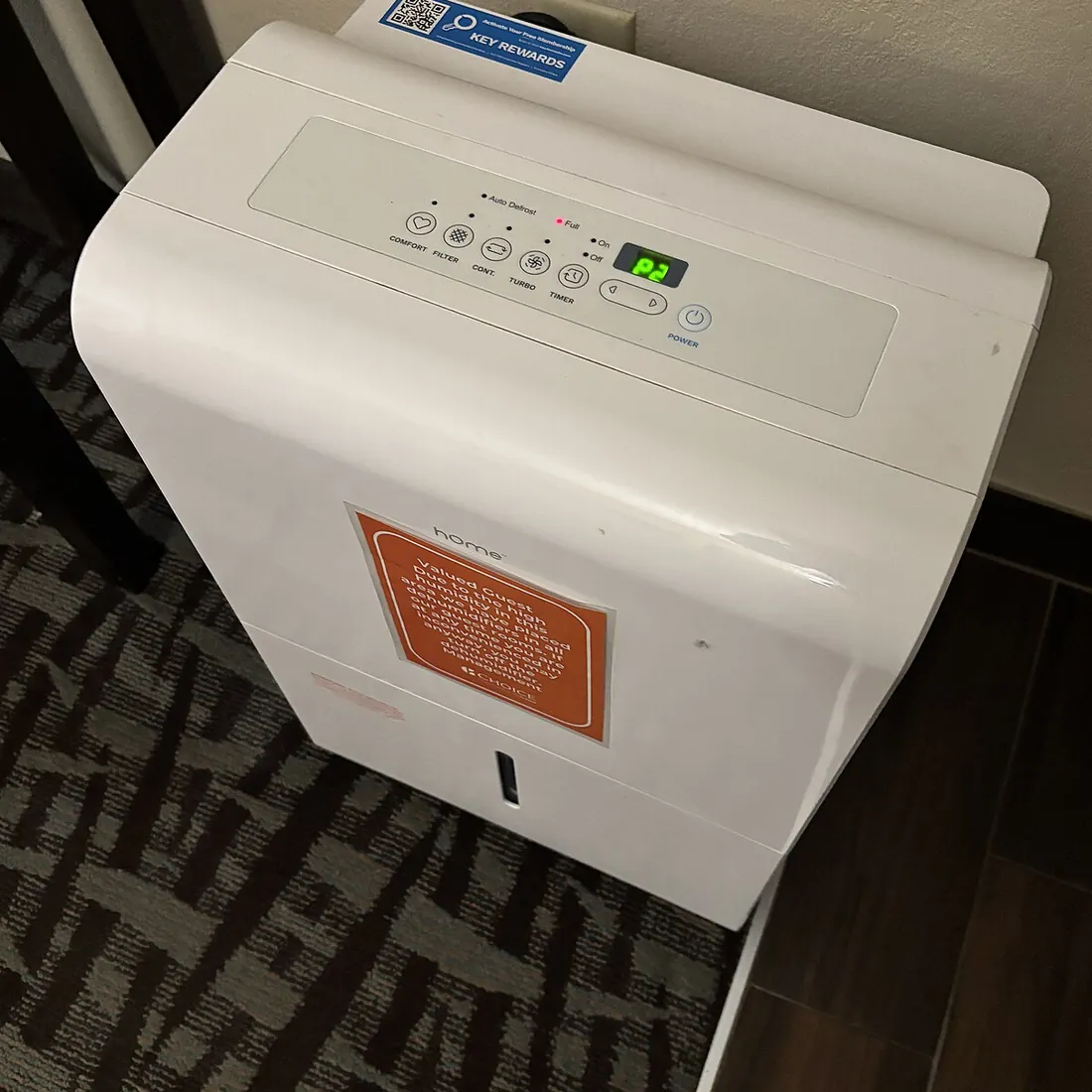
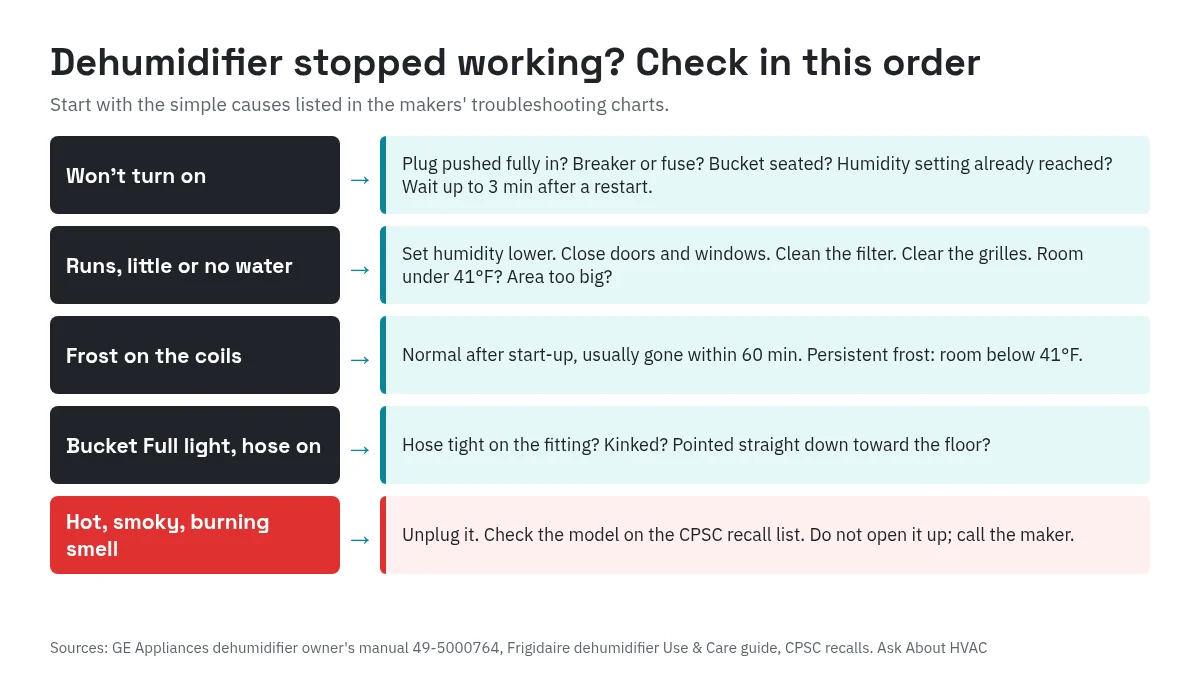
We used two owner's manuals for this guide: GE Appliances' manual for its ADYR, APYR and AWYR portable models, and Frigidaire's Use & Care guide. Your model's manual may differ in the details, so keep it handy.
1. Check the power and the plug
Start with the basics. GE's troubleshooting table lists an unplugged unit and a blown fuse or tripped breaker as the first causes of "does not start." Push the plug fully into the outlet and check your breaker panel (GE Appliances dehumidifier owner's manual).
GE also says not to run the dehumidifier on an extension cord, surge protector or multi-outlet adapter. Plug it straight into a wall outlet. If the breaker trips again after you reset it, leave it off and call a licensed pro to check the circuit.
2. Check the bucket
Most portable units won't run unless the bucket is all the way in. GE says the bucket must be in place and securely seated for the dehumidifier to operate, and that the unit turns off when the bucket is full (GE). Frigidaire's "Before You Call" table lists the same two causes, plus a BUCKET FULL light that stays on until you remove the bucket, empty it and put it back correctly (Frigidaire dehumidifier Use & Care guide).
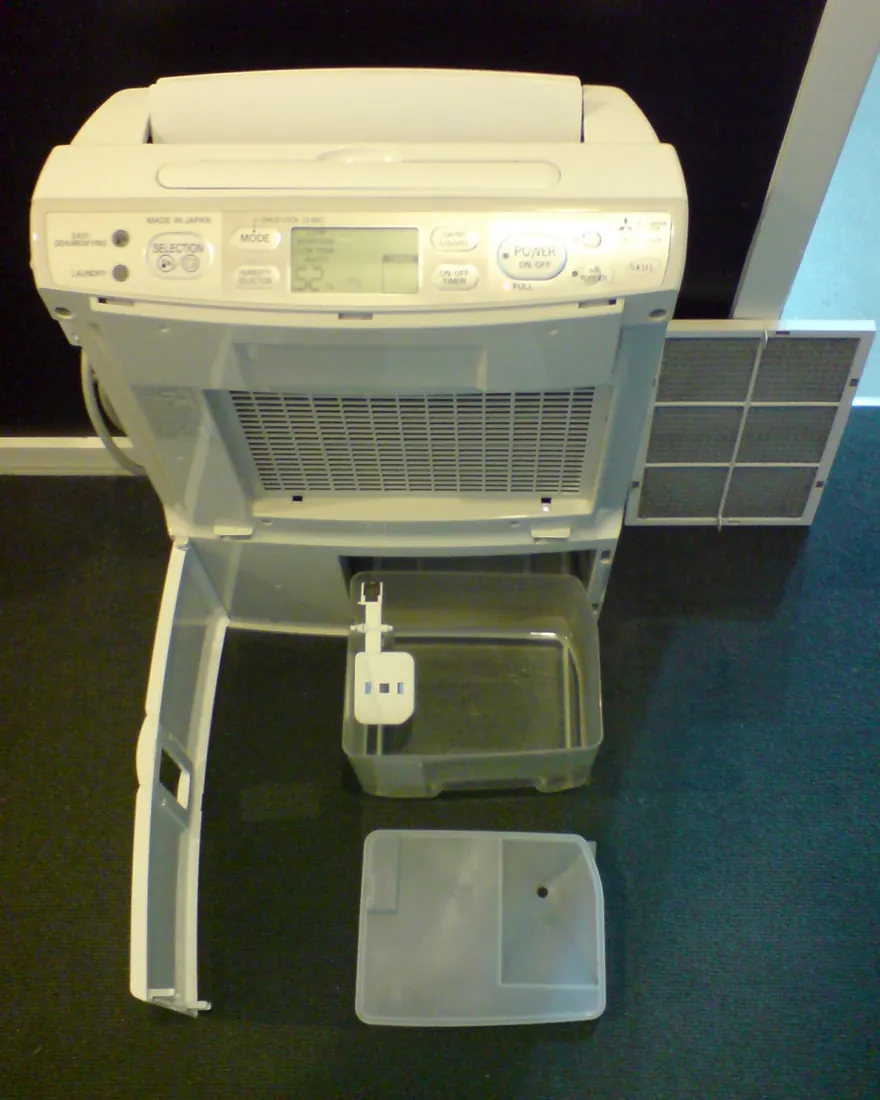
Empty the bucket, wipe the seat it sits on, and slide it back until it stops. If the light stays on with an empty bucket that's fully seated, our reasoning is that the float or level sensor is the next suspect. For models with a drain pump, GE's table lists a water level sensor issue, which may be caused by very humid conditions or a float sensor error, and says to look for a P1 code on the display. If it's there, turn the unit off, unplug it for a few seconds, plug it back in and turn it on.
3. Check the humidity setting and the restart delay
A dehumidifier that's reached its setting is doing its job. GE says it turns off automatically when the room reaches the set humidity, so try a lower setting. Frigidaire's fix is the same, or choose CONTINUOUS mode if your model has it.
After a power cut, or if you switch it off and straight back on, give it a few minutes. GE says there is a protective time delay of up to 3 minutes to prevent tripping the compressor overload, so normal dehumidifying may not start for 3 minutes (GE).
4. It runs but collects little or no water
This is the most common complaint, and the manuals list several causes that aren't faults:
| Cause | What GE and Frigidaire say to do |
|---|---|
| Humidity set too high | Set a lower percentage, or use the nonstop or continuous setting |
| Just installed | GE: allow at least 24 hours to reach the desired dryness |
| Doors and windows open | Close them |
| Clothes dryer nearby | GE: move the dehumidifier away; the dryer should vent outside |
| Dirty filter or grille | Clean it (see below) |
| Airflow blocked | Clear curtains, blinds and furniture; GE asks for at least 18 inches of space on all sides |
| Room too cool | GE and Frigidaire: designed for rooms above 41°F (5°C) |
| Area too large | The unit's capacity may not be enough |
GE also says moisture removal is best at higher room temperatures and that lower temperatures reduce the moisture removal rate (GE). That's why a unit that worked hard in August can seem lazy in a cold basement in November.
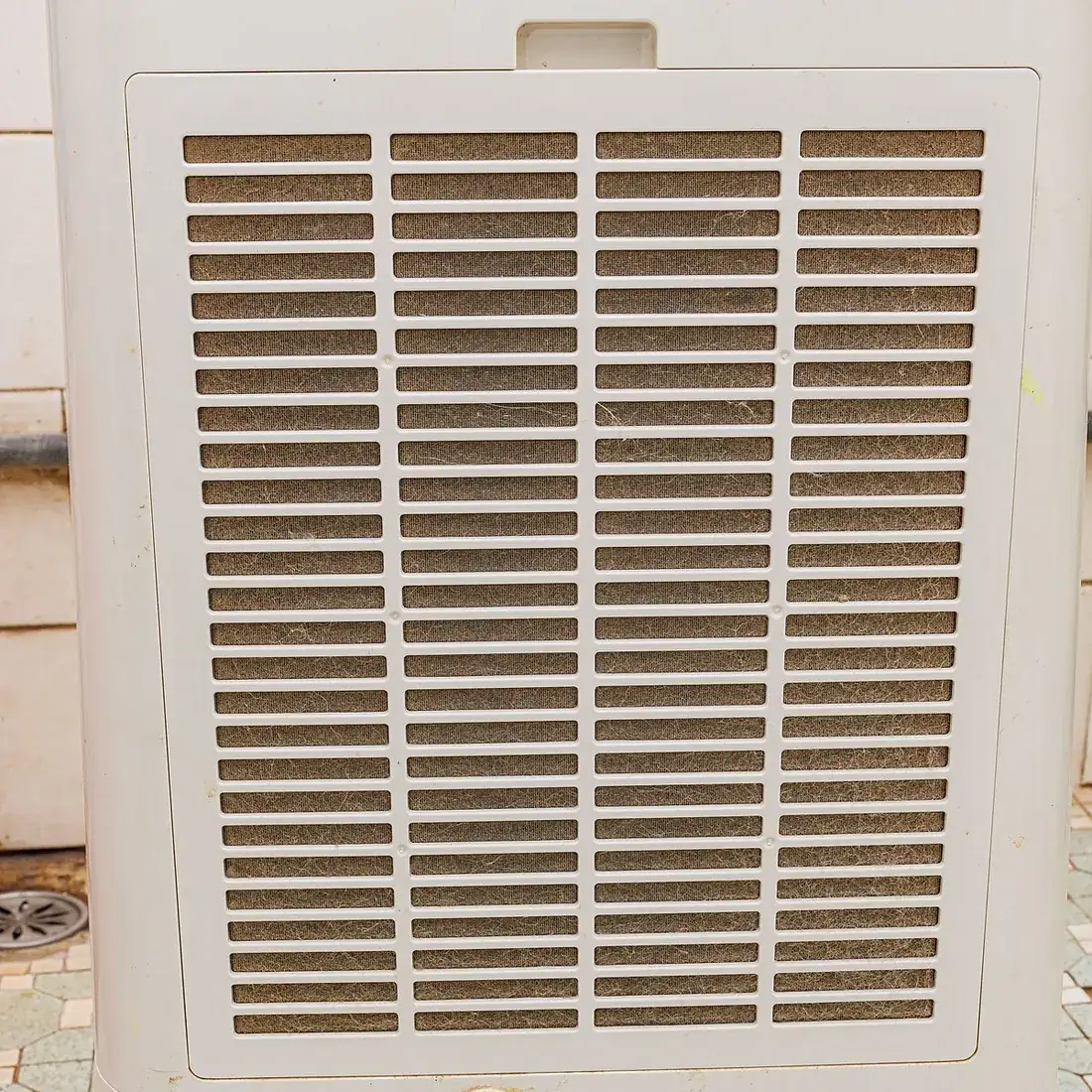
Clean the filter. GE's models light a Clean the Filter reminder after 250 hours of operation. GE says to clean the filter in warm, soapy water, rinse it and let it dry before putting it back, not to put it in a dishwasher, and not to run the unit without a filter because dirt and lint will clog it. Turn the unit off and unplug it before cleaning. Frigidaire says to vacuum a dirty grille with a brush attachment (Frigidaire).
Check the size. ENERGY STAR rates portable units by how many pints they remove per 24 hours. It says the capacity you need depends on the size of the space and how damp it is, that if you are replacing a unit you can judge by how much water you empty each day, and that it's better to oversize than undersize (ENERGY STAR dehumidifiers).
5. Frost on the coils
A little frost isn't a fault. Frigidaire says frost after start-up is normal and will usually disappear within 60 minutes. GE's models have an auto defrost: when frost forms, the compressor cycles off and the fan keeps running until the frost disappears. So a unit that blows air but collects no water for a while may simply be defrosting.
Frost that keeps coming back usually means the room is too cold. GE says to keep the unit where the temperature stays between 41°F (5°C) and 90°F (32°C), because the coils can frost below 41°F and performance drops.
6. Bucket Full light with a hose attached, or water on the floor
If you drain through a hose, GE's table lists these causes:
- Bucket Full light flashing with the hose on: the hose isn't tight on its fitting, or it's kinked. GE says the hose should run straight down to the floor with no kinks.
- Water on the floor: the hose connection may be loose, or a hose is attached while you meant to use the bucket. Disconnect the hose if you use the bucket.
- Bucket fills when using the pump (some models): pump mode isn't on, or the pump hose isn't installed properly on the back of the unit.
A gravity hose needs a drain lower than the outlet. Our reasoning: if the hose runs uphill at any point, water backs up into the bucket.
When to stop and unplug it
Some dehumidifier problems are fire hazards. Two big recalls show why a hot or smoking unit should never be pushed back into service:
- Gree (2023): about 1.56 million dehumidifiers sold under the Kenmore, GE, SoleusAir, Norpole and Seabreeze brands, made between January 2011 and February 2014. The CPSC says they can overheat, smoke and catch fire, and Gree received reports of at least 23 fires and 688 incidents of overheating. Owners should stop using and unplug them and contact Gree for a refund (CPSC Gree dehumidifier recall).
- New Widetech (2021): about 2 million units in the US, sold from February 2009 through August 2017 under brands including Amana, Danby, De'Longhi, Haier, Honeywell, Ivation and Whirlpool. New Widetech was aware of 107 incidents of overheating or fire. Owners should stop using them and contact New Widetech for a refund (CPSC New Widetech dehumidifier recall).
If yours smells hot or like burning plastic, trips the breaker over and over, or the cord or plug is warm, unplug it and look up the model number on the recall notices. Don't open the case. GE says it does not support any servicing of the dehumidifier and strongly recommends that you do not attempt to service it yourself (GE). For a wiring or outlet problem, call a licensed pro.
Repair or replace?
If the unit is past its warranty and the problem is inside the case, such as a compressor that never starts or a fan that won't spin, replacement is usually the practical route, since the makers don't support home repairs. That's our judgment, not a maker's rule.
If you replace it, ENERGY STAR says certified dehumidifiers remove the same amount of moisture as a similar conventional unit while using 20% less energy, and they come in portable and whole-home types (ENERGY STAR). A whole-home unit ties into the ductwork. Our guide on whether to set your AC fan to on or auto for humidity covers how your central system affects indoor moisture.
Keep the humidity where it should be
The reason to fix it quickly is mold. The EPA recommends keeping indoor humidity below 60%, ideally between 30% and 50%, and says a humidity meter is a small, inexpensive tool sold at many hardware stores (EPA guide to mold and moisture). GE suggests 40% to 50% for its units. If a damp, musty smell comes back while the dehumidifier is down, our guide on what different HVAC smells mean and what to do about them helps you tell mildew from other odors.
FAQ
Why did my dehumidifier stop collecting water?
Check the humidity setting first. If the room is already at or below the setting, the unit stops removing water. GE and Frigidaire also list a dirty filter, blocked airflow, open doors or windows, a room that is too large, and a room below 41°F.
Why does my dehumidifier turn on and then shut off?
It may have reached the humidity setting, the bucket may be full or not seated, or it may be defrosting. GE says that during auto defrost the compressor cycles off while the fan keeps running until the frost is gone.
Is frost on the coils normal?
Some is. Frigidaire and GE both say frost after start-up is normal and usually disappears within 60 minutes. Frost that keeps coming back usually means the room is below about 41°F, which these units aren't designed to run in.
Can I fix a dehumidifier myself?
You can do the checks in this guide, clean the filter and fix the bucket and hose. GE says it does not support servicing the unit yourself and strongly recommends against it, so leave anything inside the case to the maker's service.
What humidity should I set my dehumidifier to?
GE suggests 40% to 50% relative humidity. The EPA recommends keeping indoor humidity below 60%, ideally between 30% and 50%, to help prevent mold.
Sources
| # | Source | Site |
|---|---|---|
| 1 | Dehumidifier Owner's Manual 49-5000764 (ADYR/APYR/AWYR models), GE Appliances | products-salsify.geappliances.com |
| 2 | Dehumidifier Use & Care Guide, Frigidaire | frigidaire.bynder.com |
| 3 | Dehumidifiers, ENERGY STAR | energystar.gov |
| 4 | A Brief Guide to Mold, Moisture and Your Home, US EPA | epa.gov |
| 5 | Gree Recalls 1.56 Million Dehumidifiers (2023), US CPSC | cpsc.gov |
| 6 | Two Million Dehumidifiers Recalled, Manufactured by New Widetech (2021), US CPSC | cpsc.gov |
Every number above was checked against these sources. Found an error? See corrections or email contact@askabouthvac.com.

J.T. Bratcher
- License
- TACLB00138638E
- Type
- Texas Air Conditioning and Refrigeration Contractor License (Environmental, Class B)
- Status
- Current · expires April 11, 2027
- Checked
- October 18, 2026 via TDLR All Licenses dataset (data.texas.gov), license 138638
Related answers
- Fu · Furnaces
Why Does My Furnace Filter Collapse? 5 Causes and How to Stop It
A furnace filter folds or bows when more air pushes on it than its frame can take: a filter loaded with dust, the wrong size, a thin 1-inch filter on a big blower, or a denser filter than the system was built for. Here is how to tell which one and fix it.
- Th · Thermostats
What Size Thermostat Wire Do I Need? Gauge, Conductor Count and Cable Type
Most homes use 18 gauge solid copper thermostat wire. The real choice is how many conductors: count the terminals your system uses, add the C wire, and leave a spare. How to read 18/5 and 18/8 labels.
- Th · Thermostats
Why Does My Thermostat Go Up on Its Own? 7 Settings That Change It
A thermostat that changes by itself is usually following a setting: early start, a hold ending, a utility energy event, away mode, a learning schedule or a wrong clock. How to find which one and turn it off.