What Size Central Air Unit Do I Need? Why Square Footage Isn't Enough
| Written by | Ask About HVAC Editorial Team | Expert review | ✓ J.T. Bratcher |
|---|---|---|---|
| Published | Last reviewed | ||
| Sources | 4 cited | Reading time | 5 min |
Quick answer
The right size for a central air conditioner comes from a room-by-room load calculation, ACCA Manual J, not from your square footage. The Department of Energy says the common estimate of one ton of cooling per 400 to 500 square feet fails to account for local climate and the efficiency of the house, and that one ton can condition 800 to 1,000 square feet of a very efficient house (DOE Consumer Guide). Ask your contractor for a written Manual J and use it, with ACCA Manual S, to pick the unit.
Tons, Btu and a rough range
AC capacity is sold in tons. One ton is 12,000 Btu per hour of cooling, so DOE's example lists a 2-ton heat pump as 24,000 Btu/hr (DOE).
If you want a ballpark before a contractor visits, DOE's two figures give a wide range: 400 to 500 square feet per ton for the common rule of thumb, and 800 to 1,000 square feet per ton for a very efficient house (DOE Consumer Guide). The table below is just that arithmetic. Use it to sanity-check a quote, not to buy a unit.
| Floor area | Rule of thumb (400 to 500 sq ft per ton) | Very efficient house (800 to 1,000 sq ft per ton) |
|---|---|---|
| 1,000 sq ft | 2 to 2.5 tons | 1 to 1.25 tons |
| 1,500 sq ft | 3 to 3.75 tons | 1.5 to 1.9 tons |
| 2,000 sq ft | 4 to 5 tons | 2 to 2.5 tons |
| 2,500 sq ft | 5 to 6.25 tons | 2.5 to 3.1 tons |
The gap between the two columns is the point. A quote far outside the range for your house deserves a question, and only a load calculation settles it.
Same house size, very different AC size
DOE's sizing fact sheet compares a hypothetical 2,000-square-foot home in Raleigh, North Carolina, built two ways (DOE):
| Conventional construction | With efficiency upgrades | |
|---|---|---|
| Wall / ceiling insulation | R-11 / R-19 | R-19 / R-38 |
| Windows | Single pane | Double-glazed, low-e |
| Ducts | Average leakage, in unconditioned attic | No leakage, inside conditioned space |
| Manual J design cooling load | 52,100 Btu/hr | 23,300 Btu/hr |
| Heat pump size | 4.0 to 4.5 tons | 2 tons (24,000 Btu/hr) |
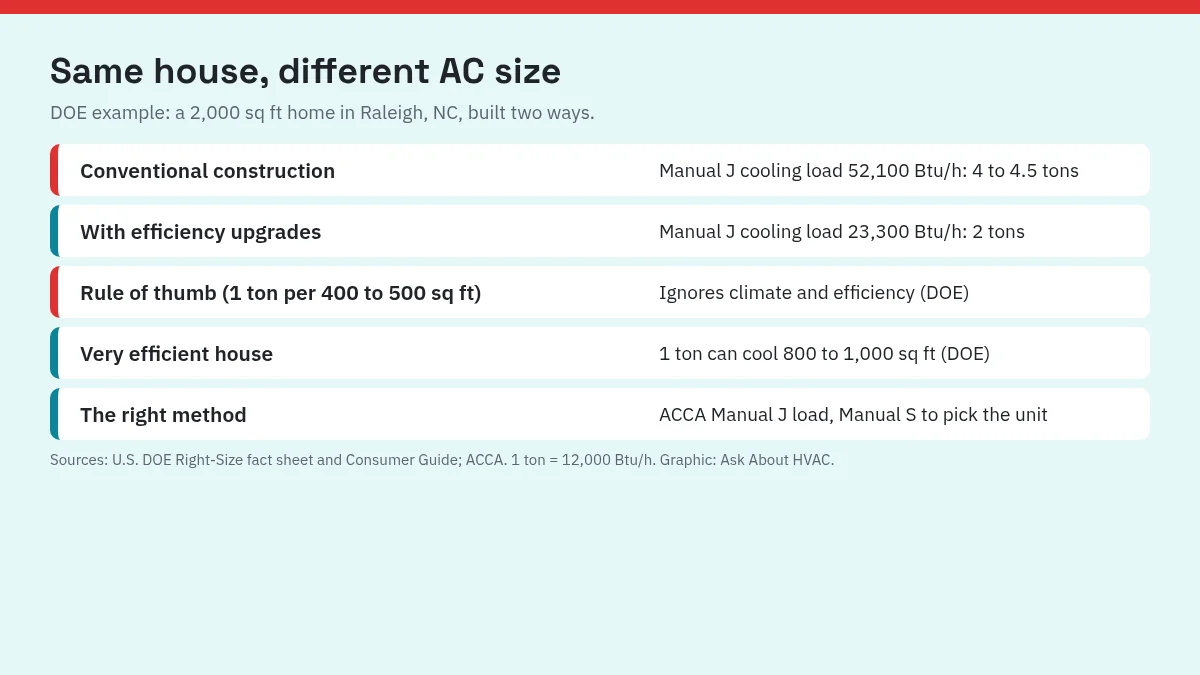
Same floor area, more than double the cooling load. That's why a square-foot chart can be off by a wide margin.
What a Manual J calculation looks at
ACCA describes Manual J as the national ANSI-recognized standard for producing HVAC equipment sizing loads for homes, and says a load calculation done to it is required by national building codes and most state and local jurisdictions (ACCA). According to DOE, Manual J determines heating and cooling loads from (DOE):
- Wall, ceiling, window and floor areas and their insulation values
- Air leakage of the building and the ducts
- Building orientation, roof surface color and occupancy
Once the loads are known, Manual S is used to select equipment that matches them.
Why oversizing is a problem
It's tempting to go bigger "just in case." The ENERGY STAR fact sheet on right-sized air conditioners explains why that backfires (EPA ENERGY STAR):
| Problem with an oversized AC | What happens |
|---|---|
| Short-cycling | The unit runs in short bursts; AC efficiency is low at startup and peaks after about 10 minutes |
| Poor humidity control | Short runs reduce the condensation that drains off the coil; damp air can promote mold and mildew |
| Comfort | Bursts of cold air can trick the thermostat into shutting off before the whole house is cool |
| Wear | Short-cycling increases wear and tear and can mask problems like dirty filters or leaky ducts |
| Cost | Bigger units cost more to buy |
DOE also cites a Florida study in which units oversized by 50 percent or more used about 9 percent more cooling electricity a year and had 13 percent higher summer peak demand (DOE).
DOE adds that oversized systems use more fan power and often show more duct leakage because of higher duct pressures. Our guide on how long an AC should take to cool one degree explains how to spot short-cycling at home.
Ducts can eat the capacity
Ducts in a hot attic matter as much as the unit. DOE's fact sheet says simulation studies show cooling systems can lose 30 percent of their peak sensible capacity from heat gained by ducts in unconditioned space, and duct leakage can have even larger effects (DOE). That's a reason to fix ducts before upsizing, not to buy a bigger unit to make up for them.
DOE also gives an airflow target for heat pumps of 400 to 500 cubic feet per minute per ton of cooling capacity, and notes that inadequate airflow can cost 5 percent or more of a system's performance.
Heat pumps and cold climates
A heat pump is sized for both heating and cooling. DOE notes that Manual S advises that, in colder climates, heat pumps can be sized up to 25 percent larger than the required cooling size to reduce use of backup resistance heat (DOE). In that case, ask about units that adjust blower speed for humidity, which DOE says can help keep cooling comfortable.
Don't size for fast cool-downs
Some people want a bigger unit so the house cools fast after work. DOE suggests a programmable thermostat instead, so the house is cooled before you arrive. That avoids the temptation to oversize for rapid cool-downs (DOE).
What to ask your contractor
DOE's fact sheet advises insisting on documented Manual J sizing calculations and using Manual S to select the equipment. Questions that follow from that guidance:
- Will you do a Manual J for my house? Ask for the written report, not a verbal estimate.
- What design temperatures did you use? DOE says not to alter the suggested design temperatures for your location, because using annual extremes leads to oversizing. For cooling, Manual J uses the 97.5 percent design temperature, and it generally recommends 75°F indoors.
- Did you account for my upgrades? New windows, insulation or air sealing lower the load. DOE says the recommended size should drop as a home's efficiency improves.
- How did you pick the model? The answer should reference Manual S and the Manual J loads.
- Are the ducts sized for it? A new unit is only as good as the ducts that carry its air.
Replacing an old unit with the same size
Don't assume the old size was right. DOE's fact sheet cites a large survey in which nearly 40 percent of contractors said they purposely oversized equipment. If your home has had energy upgrades since the old unit went in, the load may be lower now. A fresh Manual J is the way to know. When choosing among correctly sized units, the next decision is efficiency; our guide on what a good SEER rating is covers that.
FAQ
How many square feet does a 3-ton AC cool?
There's no fixed answer. DOE says the common estimate of 1 ton per 400 to 500 square feet ignores climate and the home's efficiency, and that 1 ton can condition 800 to 1,000 square feet of a very efficient house. A Manual J calculation gives the real number.
Is a bigger AC better?
No. DOE and ENERGY STAR both say oversized units cost more, short-cycle, run less efficiently and remove less humidity, which can leave the house clammy.
What is a ton of air conditioning?
A measure of cooling capacity. DOE's sizing fact sheet lists a 2-ton heat pump as 24,000 Btu per hour, so 1 ton is 12,000 Btu per hour.
Can I just replace my AC with the same size?
Your old unit may not have been sized correctly, and insulation, windows or duct changes since then change the load. DOE says that as a home's efficiency improves, the recommended system size should drop. Ask for a new Manual J.
Sources
| # | Source | Site |
|---|---|---|
| 1 | Consumer Guide to Home Heating and Cooling, U.S. Department of Energy | energy.gov |
| 2 | Right-Size Heating and Cooling Equipment (Technology Fact Sheet), U.S. Department of Energy | www1.eere.energy.gov |
| 3 | Right-Sized Air Conditioners (ENERGY STAR fact sheet), U.S. EPA | energystar.gov |
| 4 | Manual J Residential Load Calculation, ACCA | acca.org |
Every number above was checked against these sources. Found an error? See corrections or email contact@askabouthvac.com.

J.T. Bratcher
- License
- TACLB00138638E
- Type
- Texas Air Conditioning and Refrigeration Contractor License (Environmental, Class B)
- Status
- Current · expires April 11, 2027
- Checked
- October 18, 2026 via TDLR All Licenses dataset (data.texas.gov), license 138638
Related answers
- Ac · Air Conditioning
AC Refrigerant Leak Signs: 7 Clues and What to Do Next
Common signs of an AC refrigerant leak: warm air from the vents, higher humidity, ice on the coil or lines, hissing or bubbling, oily residue at fittings, and rising bills. Shut the system off and call an EPA-certified technician to find and fix the leak, not just top it off.
- Ac · Air Conditioning
How Long Should an AC Take to Cool 1 Degree? Why There Is No Single Number
There is no industry standard for minutes per degree. What a normal AC run looks like in mild weather vs a heat wave, why sites disagree, and a 1-hour test to tell if yours is too slow.
- Ac · Air Conditioning
Water Dripping From Your Furnace in Summer? It's Usually the AC Drain
Water under a furnace in summer almost always comes from the AC coil sitting on top of it, not the furnace. A 2-minute check to find the source, a cause table, and safe fixes.