What Is a Good SEER Rating in 2026? SEER2 Minimums vs ENERGY STAR
| Written by | Ask About HVAC Editorial Team | Expert review | ✓ J.T. Bratcher |
|---|---|---|---|
| Published | Last reviewed | ||
| Sources | 7 cited | Reading time | 5 min |
Quick answer
For a new central air conditioner, a good SEER rating is at least the ENERGY STAR level: 15.2 SEER2 with 12.0 EER2 for a split system (ENERGY STAR Version 6.1). The federal minimum, in effect since January 1, 2023, is 13.4 SEER2 in the North and 14.3 SEER2 in the Southeast and Southwest for split ACs under 45,000 Btu/h (10 CFR 430.32). Going above 15.2 makes the most sense where the AC runs many hours a year.
SEER2 ratings at a glance
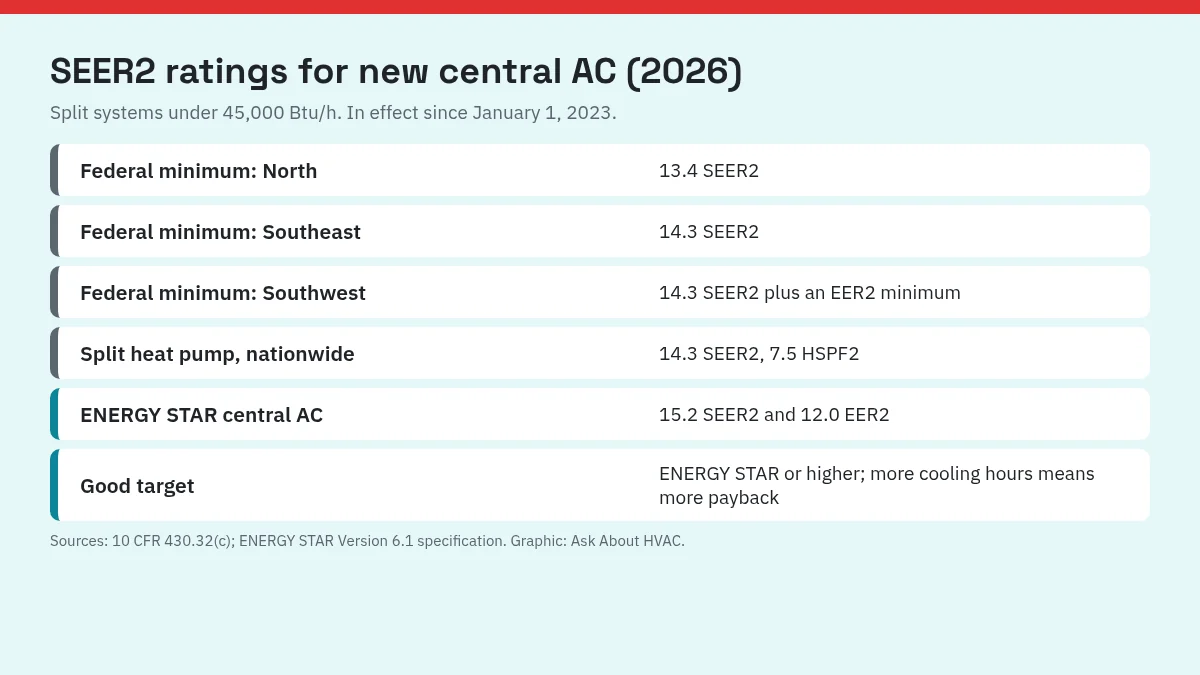
| Equipment | Federal minimum, North | Federal minimum, Southeast | Federal minimum, Southwest | ENERGY STAR |
|---|---|---|---|---|
| Split AC, under 45,000 Btu/h | 13.4 SEER2 | 14.3 SEER2 | 14.3 SEER2 + EER2 minimum | 15.2 SEER2, 12.0 EER2 |
| Split AC, 45,000 Btu/h and up | 13.4 SEER2 | 13.8 SEER2 | 13.8 SEER2 + EER2 minimum | 15.2 SEER2, 12.0 EER2 |
| Single-package AC | 13.4 SEER2 | 13.4 SEER2 | 13.4 SEER2 + 10.6 EER2 | 15.2 SEER2, 11.5 EER2 |
| Split heat pump | 14.3 SEER2, 7.5 HSPF2 | Same | Same | 15.2 SEER2, 11.0 EER2, 7.8 HSPF2 |
Sources: 10 CFR 430.32(c)(5)–(6); ENERGY STAR.
In the Southwest, split ACs under 45,000 Btu/h also need 11.7 EER2 if rated below 15.2 SEER2, or 9.8 EER2 if rated at 15.2 SEER2 or higher. Units 45,000 Btu/h and up need 11.2 or 9.8 EER2 on the same split. The regulation defines the Southeast as Alabama, Arkansas, Delaware, Florida, Georgia, Hawaii, Kentucky, Louisiana, Maryland, Mississippi, North Carolina, Oklahoma, Puerto Rico, South Carolina, Tennessee, Texas, Virginia, D.C. and the U.S. territories, and the Southwest as Arizona, California, Nevada and New Mexico. Everywhere else uses the national minimums.
What SEER2, EER2 and HSPF2 mean
ENERGY STAR defines them, based on DOE's test procedure (ENERGY STAR):
- SEER2: total heat removed over a cooling season, in Btu, divided by the electricity used, in watt-hours. Higher is more efficient over a season.
- EER2: cooling delivered divided by electricity used at a single set of conditions. The federal rule rates it at 95 °F outdoors, which is why it matters in very hot climates.
- HSPF2: the heating-season version for heat pumps.
The "2" means the rating comes from DOE's newer test procedure, Appendix M1. Older SEER, EER and HSPF ratings came from Appendix M. Because the tests differ, compare SEER2 numbers only with other SEER2 numbers.
How to decide how high to go
A higher SEER2 rating saves more when the AC runs more. An ENERGY STAR fact sheet on air conditioners, published in 2000, notes that air conditioning accounts for 15 percent of home energy use on average and over 40 percent in hot, humid regions (EPA ENERGY STAR). In a mild climate with a short cooling season, the minimum or ENERGY STAR level is often enough. In a long, hot cooling season, a higher rating has more hours to pay back its higher price.
Compare quotes on the same basis:
- Get the matched-system rating. The rating applies to the specific outdoor and indoor combination. The federal rule says an outdoor unit with any certified combination rated below the regional standard cannot be installed in that region.
- Check the EnergyGuide label. ENERGY STAR requires that the SEER2 and HSPF2 it lists match what was reported to DOE and shown on the FTC EnergyGuide label.
- Check EER2 if you live somewhere very hot. It reflects performance at 95 °F.
- Size it correctly first. An oversized high-SEER2 unit short-cycles and won't deliver its rated efficiency. Our guide to sizing a central air unit with a Manual J load calculation covers that step.
Do the math for your own house
Because SEER2 is Btu of cooling per watt-hour of electricity (ENERGY STAR), you can estimate the difference between two units with simple division. Take your seasonal cooling load in Btu, divide by the SEER2, and divide by 1,000 to get kilowatt-hours.
The table uses an example load of 30 million Btu per season. That number is for illustration only; your load depends on climate, house size and insulation.
| SEER2 | Electricity for 30 million Btu | Difference vs 13.4 |
|---|---|---|
| 13.4 (federal minimum, North) | 2,239 kWh | none |
| 15.2 (ENERGY STAR) | 1,974 kWh | 265 kWh less |
| 18.0 | 1,667 kWh | 572 kWh less |
Multiply the difference by the rate on your electric bill to get dollars per year. Then compare that with the price gap between the two quotes. The step from 13.4 to 15.2 saves more per SEER2 point than the step from 15.2 to 18, because each extra point divides into a smaller number. That is why the gains shrink as ratings climb.
A heat pump also heats, so for one, run the same comparison for heating with HSPF2 and your heating load.
Look up the exact combination
Ask each contractor for the model numbers of the outdoor unit, the indoor coil or air handler, and the furnace if there is one. The federal rule ties the rating to that certified combination (10 CFR 430.32). The AHRI Directory of Certified Product Performance lets you search those model numbers and see the certified SEER2, EER2 and HSPF2 for the match (AHRI Directory). If a quote lists only the outdoor unit, the efficiency on it may not be the one you get.
Federal tax credit: ended for 2026 installs
Until the end of 2025, some high-efficiency central air conditioners and heat pumps qualified for the section 25C energy efficient home improvement credit. The One, Big, Beautiful Bill ended it early. The IRS says the credit will not be allowed for any property placed in service after December 31, 2025 (IRS). A system installed in 2026 gets no 25C credit, so leave it out of your payback math. Check with your utility and state energy office for any local rebates instead.
Don't skip installation quality
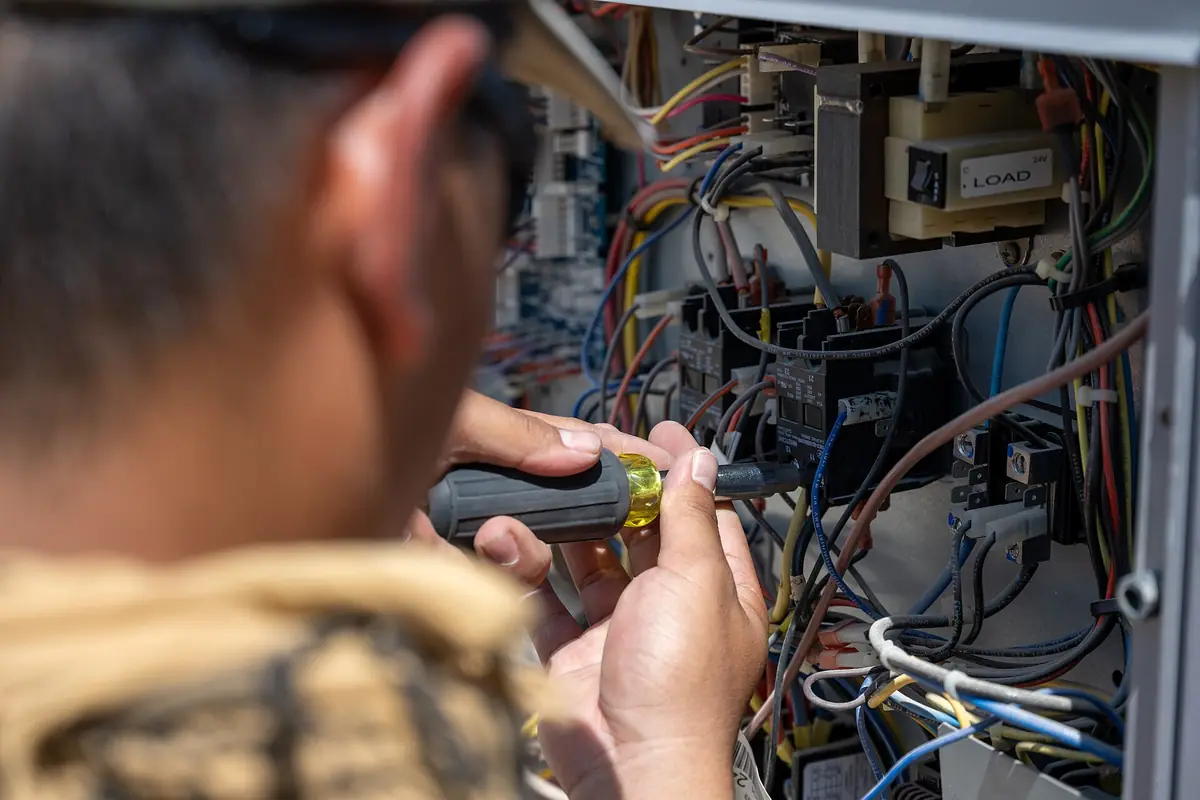
A rating is measured in a lab with the system installed and charged as designed. Refrigerant charge, airflow and duct leakage in your home affect what you actually get. ENERGY STAR's maintenance checklist notes that too much or too little refrigerant makes a system less efficient, and that airflow problems can reduce efficiency by up to 15 percent (ENERGY STAR).
FAQ
Is 14 SEER good?
Ratings made since 2023 use SEER2, a different test procedure, so a '14 SEER' number from an older unit isn't directly comparable. For new equipment, 14.3 SEER2 is the federal minimum for most split ACs in the South and for split heat pumps nationwide, so it's the floor, not a premium rating.
What SEER2 rating qualifies for ENERGY STAR?
Under ENERGY STAR Version 6.1, split-system central ACs need at least 15.2 SEER2 and 12.0 EER2; split heat pumps need at least 15.2 SEER2, 11.0 EER2 and 7.8 HSPF2.
What's the difference between SEER2 and EER2?
SEER2 measures cooling efficiency over a whole cooling season. EER2 measures efficiency at a fixed hot condition of 95 °F outdoors, which matters in very hot climates; the Southwest has an EER2 minimum for that reason.
Can I still install an older SEER-rated unit?
Only if it meets the SEER2 standard for your region. The federal rule says an outdoor unit with a certified combination rated below the regional standard cannot be installed in that region.
Sources
| # | Source | Site |
|---|---|---|
| 1 | 10 CFR 430.32(c), Energy and water conservation standards: central air conditioners and heat pumps (eCFR) | ecfr.gov |
| 2 | ENERGY STAR Version 6.1 Central Air Conditioner and Heat Pump Final Specification, U.S. EPA | energystar.gov |
| 3 | Heat Pump Equipment Key Product Criteria, ENERGY STAR | energystar.gov |
| 4 | Right-Sized Air Conditioners (ENERGY STAR fact sheet), U.S. EPA | energystar.gov |
| 5 | IRS: FAQs for modification of section 25C and other credits under Public Law 119-21 | irs.gov |
| 6 | AHRI Directory of Certified Product Performance | ahridirectory.org |
| 7 | ENERGY STAR: Maintenance Checklist | energystar.gov |
Every number above was checked against these sources. Found an error? See corrections or email contact@askabouthvac.com.

J.T. Bratcher
- License
- TACLB00138638E
- Type
- Texas Air Conditioning and Refrigeration Contractor License (Environmental, Class B)
- Status
- Current · expires April 11, 2027
- Checked
- October 18, 2026 via TDLR All Licenses dataset (data.texas.gov), license 138638
Related answers
- Ac · Air Conditioning
What Size Central Air Unit Do I Need? Why Square Footage Isn't Enough
The right central AC size comes from an ACCA Manual J load calculation, not square footage. The old rule of 1 ton per 400 to 500 sq ft ignores climate and insulation; DOE notes 1 ton can cool 800 to 1,000 sq ft of a very efficient house. Here's how sizing works and what to ask your contractor.
- Ac · Air Conditioning
AC Refrigerant Leak Signs: 7 Clues and What to Do Next
Common signs of an AC refrigerant leak: warm air from the vents, higher humidity, ice on the coil or lines, hissing or bubbling, oily residue at fittings, and rising bills. Shut the system off and call an EPA-certified technician to find and fix the leak, not just top it off.
- Du · Ducts & Airflow
Why Are My Air Ducts Popping? Normal Pings vs Sounds to Fix
Light pings when the heat starts or stops are normal duct expansion. A loud bang when the blower shuts off is oil-canning. What to check, and when to call a pro.