Ice on Your Heat Pump: Normal Frost or a Problem?
| Written by | Ask About HVAC Editorial Team | Expert review | Pending |
|---|---|---|---|
| Published | Last updated | ||
| Sources | 4 cited | Reading time | 5 min |
Quick answer
Some frost on a heat pump in winter is normal. The outdoor coil runs colder than the outside air, moisture freezes on it, and the unit melts it off with an automatic defrost cycle that usually lasts a few minutes. It becomes a problem when the ice gets thick, keeps growing, covers the top or fan, or does not clear after defrost cycles. That points to a failed defrost control or sensor, low refrigerant, an airflow problem or a drainage problem (Trane; Lennox).
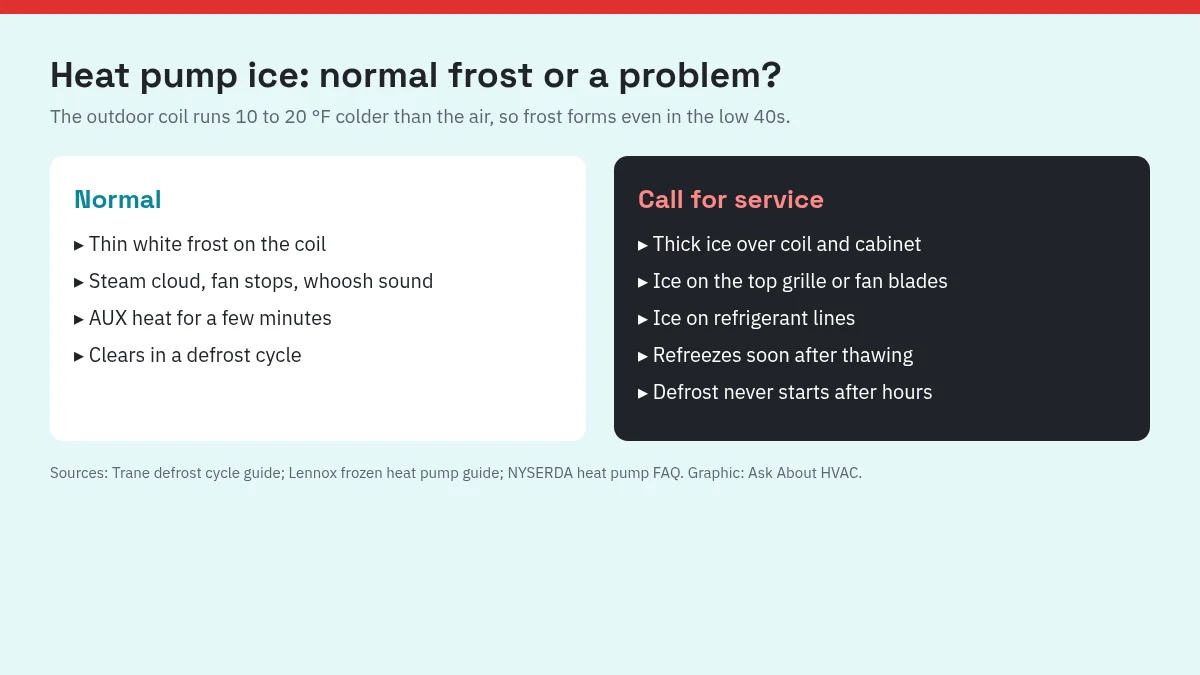
Normal frost or a real freeze-up?
| What you see | Normal or problem | Why |
|---|---|---|
| Thin white frost on the coil fins | Normal | Clears in the next defrost cycle |
| Cloud of steam from the unit, fan stopped, a whoosh sound | Normal | The defrost cycle running |
| Frost in the low 40s °F outside | Normal | The coil runs 10 to 20 °F colder than the air |
| AUX heat showing on the thermostat for a few minutes | Normal | Backup heat covers the defrost cycle |
| Thick ice coating the whole coil and cabinet | Problem | Defrost not keeping up or not happening |
| Ice on the top grille or blocking the fan blades | Problem | Airflow blocked, possible fan damage |
| Ice on only one side or in odd patterns | Problem | Lennox lists this as a reason to call |
| Ice on the refrigerant lines | Problem | Lennox lists this as a reason to call |
| Unit refreezes soon after thawing | Problem | Points to refrigerant, airflow or defrost faults |
Sources: Trane defrost cycle guide, Lennox.
Why a heat pump frosts up even above freezing
Trane explains that in winter the outdoor coil is typically 10 to 20 °F colder than the outdoor air. It collects condensation the way a glass of ice water does, and when the coil is cold enough, that water freezes. So a heat pump can go into defrost when it is in the low 40s outside, though it is more common in the 20s and 30s (Trane).
NYSERDA puts it simply: when the outdoor coil is below 32 °F, condensation on it freezes into a layer of frost, and the heat pump switches into a defrost cycle (NYSERDA).
What a defrost cycle looks and sounds like
During defrost, the reversing valve sends hot refrigerant to the outdoor coil, which briefly puts the heat pump into cooling mode. You may notice:
- A cloud of steam rising from the outdoor unit.
- A swooshing sound as the refrigerant reverses.
- The outdoor fan stopping.
- The compressor getting louder or quieter.
- AUX heat on the thermostat while backup heat keeps the house warm.
- Cool air from the vents, only if the system has no backup heat.
All of these come from Trane's guide, which calls them normal (Trane).
How long and how often varies by system:
| Source | Defrost length | How often |
|---|---|---|
| Trane (demand defrost) | Usually 3 to 5 minutes | Only when sensors detect ice |
| NYSERDA | Typically 5 to 15 minutes | When the coil is below 32 °F |
| Lennox | Not stated | Every 30 to 90 minutes in frosting conditions |
Trane notes that many heat pumps use timed defrost instead, running after a set number of hours and for a set length whether ice is there or not (Trane). Your owner's manual will say which type you have.
What causes a heat pump to freeze up
Lennox lists these causes of heavy ice (Lennox):
| Cause | What it means | Can you fix it? |
|---|---|---|
| Defrost control failure | Board, timer or sensor fails, so defrost never starts | No, a technician |
| Low refrigerant | Usually a leak; coil gets too cold | No, a technician |
| Restricted airflow | Dirty filter, debris or snow at the unit, blocked ducts or closed vents | Often yes |
| Drainage problem | Melt water pools under the unit and refreezes | Sometimes (clear the base, check gutters) |
| Extreme weather | Freezing rain, sleet or heavy wet snow can overwhelm defrost | Wait and clear snow |
| Failed parts | Reversing valve, outdoor fan motor | No, a technician |
Trane adds that ice which is not going away, or is growing, likely means low refrigerant, a faulty defrost control or a faulty sensor (Trane).
What to do if your heat pump is iced over
Steps from Lennox and Trane:
- Wait first. Trane suggests waiting a few hours to see if the unit defrosts itself.
- If ice is heavy and the house is not heating, set the thermostat to Off, or to Emergency Heat if you have it. Lennox says Emergency Heat lets the outdoor unit thaw while keeping the house warm.
- Clear at least two feet around the unit of snow, leaves and debris. Do not pile snow against the sides.
- Check the indoor air filter and replace it if it is dirty.
- Make sure supply vents inside are open and not blocked by furniture.
- Check that gutters and downspouts do not drain onto the unit.
- Let it thaw naturally. Lennox says this typically takes 2 to 4 hours above freezing. If the ice has not melted in 6 to 8 hours, or it refreezes quickly, call a technician.
A dirty filter is one of the few freeze-up causes you can fix yourself; our guide on how to tell if your furnace filter needs changing covers the checks. If the thermostat shows a message such as "Waiting for equipment" when you switch back to heat, that is usually a built-in compressor delay.
What not to do
- Do not pour hot water on the unit. Lennox warns the sudden temperature change can crack components.
- Do not chip or pry at the ice. Tools can bend the coil fins and fan blades, and a small dent reduces efficiency.
- Do not wrap or cover the sides. NYSERDA says the outdoor unit needs airflow and should not be covered in winter; protect it from roof snow with placement under an eave or a snow shield (NYSERDA).
When to call for service
Lennox's list of reasons to call a dealer includes (Lennox):
- The unit refreezes quickly after thawing.
- Refrigerant lines are covered in ice, inside or outside.
- The outdoor fan does not spin after the ice melts.
- Grinding, squealing or banging noises.
- Ice forms only on one side or in unusual patterns.
- The defrost cycle never starts after several hours of running.
Trane adds: if the unit seems to be constantly switching into defrost, or defrost cycles keep getting longer while ice spreads, call for service (Trane).
FAQ
Is it normal for a heat pump to have ice on it in winter?
A light layer of frost on the outdoor coil is normal in cold, humid weather. The unit runs a defrost cycle to melt it. Thick ice that covers the cabinet, top or fan, or keeps growing, is not normal.
How often should a heat pump defrost?
Lennox says a heat pump should defrost itself every 30 to 90 minutes in frosting conditions. Units with demand defrost, such as Trane's, defrost only when sensors detect ice, so the interval varies.
Can I pour hot water on a frozen heat pump?
No. Lennox warns that the sudden temperature change can crack components, and chipping at ice can bend the coil fins and fan blades.
Why is steam coming off my heat pump?
That is usually the defrost cycle. Trane explains that the steam is melting frost evaporating off the warm outdoor coil, and it is normal.
Should I cover my heat pump in winter?
NYSERDA says not to cover it, because the outdoor unit needs airflow. Protect it from snow and ice falling off the roof with placement or a top-only snow shield.
Sources
Every number above was checked against these sources. Found an error? See corrections or email contact@askabouthvac.com.
Expert review status: pending
The editorial fact-check of this guide is complete. It is queued for review by J.T. Bratcher, a Texas-licensed air conditioning contractor. His name and the review date will appear here and at the top of the page only after he approves it.
Related answers
- Th · Thermostats
Should Your AC Fan Be On or Auto? What the Humidity Research Shows
In humid climates, keep the AC fan on Auto: measured tests show fan On puts water from the coil back into your air. When On or Circulate makes sense, and a simple test for your home.
- Fu · Furnaces
Furnace Filter Put In Backwards? Which Way the Arrow Goes and What to Do
The airflow arrow on a furnace filter points toward the blower, away from the return duct. If yours is in backwards, turn the system off and flip it. Here is how to find the right direction when the arrow is missing or hard to read.
- Ac · Air Conditioning
How Long Should an AC Take to Cool 1 Degree? Why There Is No Single Number
There is no industry standard for minutes per degree. What a normal AC run looks like in mild weather vs a heat wave, why sites disagree, and a 1-hour test to tell if yours is too slow.