Does Ductwork Need to Be Cleaned? When It Helps and When It's a Sales Pitch
| Written by | Ask About HVAC Editorial Team | Expert review | ✓ J.T. Bratcher |
|---|---|---|---|
| Published | Last reviewed | ||
| Sources | 7 cited | Reading time | 9 min |
Quick answer
Usually, no. The U.S. Environmental Protection Agency does not recommend cleaning air ducts as routine maintenance, only as needed. EPA's guidance names three situations where cleaning makes sense: substantial visible mold inside the ducts or on other parts of the system, ducts infested with rodents or insects, and ducts clogged with so much dust and debris that particles blow out of the supply registers. A light layer of dust is normal, and EPA says there is no evidence that it poses a health risk.
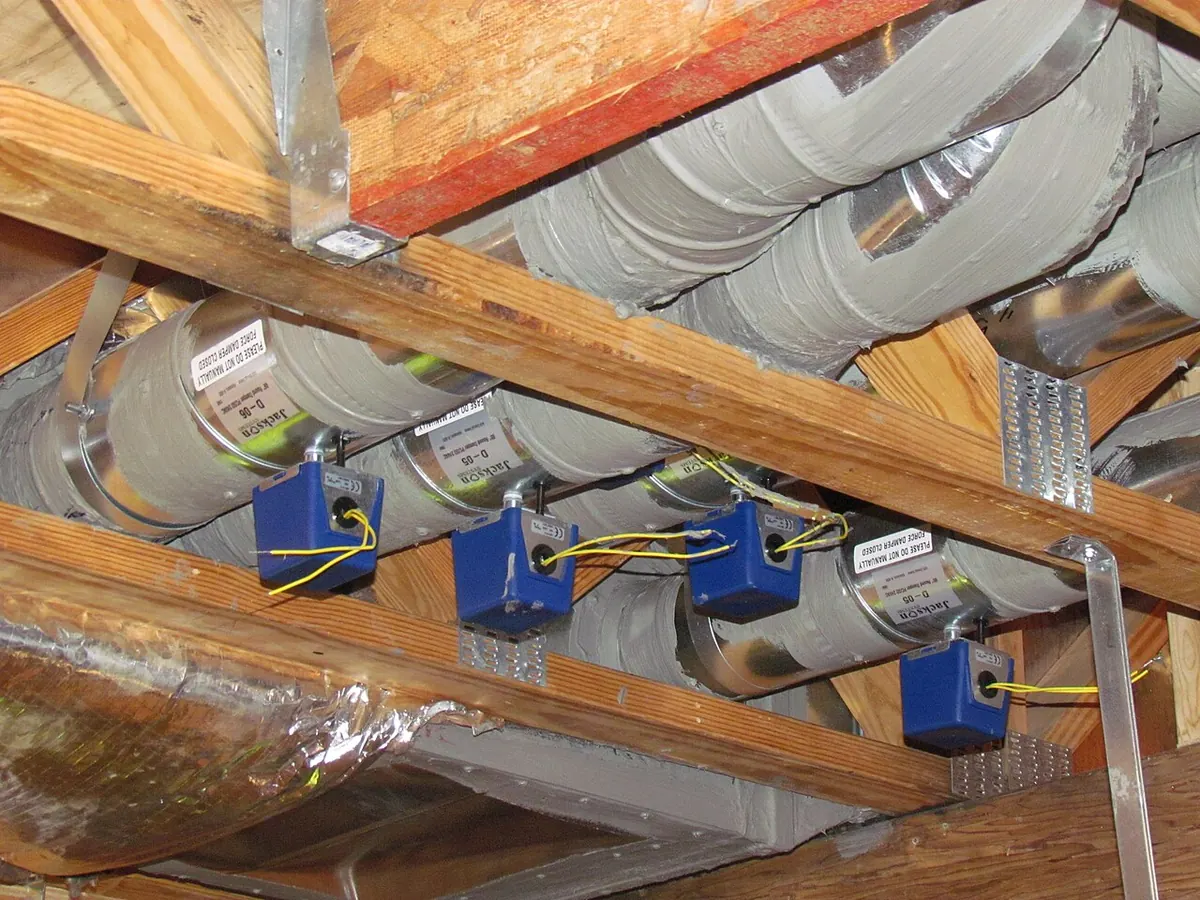
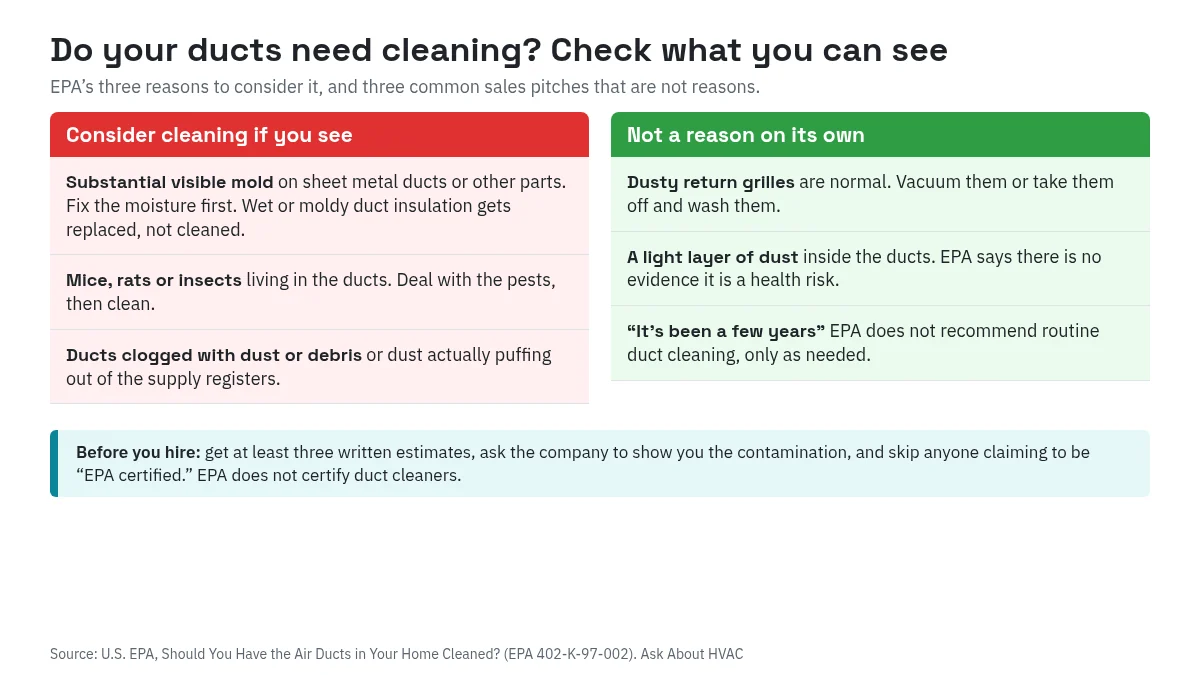
The rest of this guide covers how to check your own ducts, the sales tactics state attorneys general have warned about, how to hire well if you do need cleaning, and how to keep ducts clean in the first place.
1. What EPA actually says about duct cleaning
EPA's homeowner guide, Should You Have the Air Ducts in Your Home Cleaned?, is the source most other pages quote, but few quote it in full. The main points:
- No routine schedule. EPA does not recommend that air ducts be cleaned routinely, but only as needed. It also says duct cleaning is not considered a necessary part of yearly maintenance, which consists of cleaning drain pans and coils, regular filter changes and yearly inspections of heating equipment.
- Health benefits are unproven. EPA says duct cleaning has never been shown to actually prevent health problems. On the open question of whether it does, its answer is "no one knows."
- Efficiency benefits are mostly about other parts. Some research suggests that cleaning cooling coils, fans and heat exchangers can improve efficiency, but EPA says little evidence exists that cleaning only the ducts will.
- The furnace check matters more. If you have a fuel-burning furnace, stove or fireplace, EPA does recommend having it inspected and serviced before each heating season to protect against carbon monoxide poisoning.
EPA's shorter answer page on duct cleaning and mold puts moisture first: the key to mold control is moisture control, so clean up mold promptly, fix the water problem, and dry water-damaged areas within 24 to 48 hours.
2. The three real reasons to clean
Substantial visible mold. This means mold growing inside hard-surface ducts, such as sheet metal, or on other parts of the heating and cooling system. EPA adds three cautions. Many parts of the system can't be seen, so ask any company to show you the mold they say is there. Something that looks like mold may not be, and only an expert or lab test can confirm it; EPA notes that some microbiology labs will identify a sample on a strip of clear tape for about $50 (a figure from the guide's 1997 text). And if the moisture that caused the mold isn't fixed, the mold will come back.
Insulated ducts are different. If insulated ducts or fiberglass duct liner get wet or moldy, EPA says the insulation cannot be effectively cleaned and should be removed and replaced. EPA, NADCA and the insulation makers' trade group NAIMA all recommend replacing wet or moldy fiberglass duct material. So for lined ducts or duct board, the fix is replacement by a heating and cooling contractor, not cleaning.
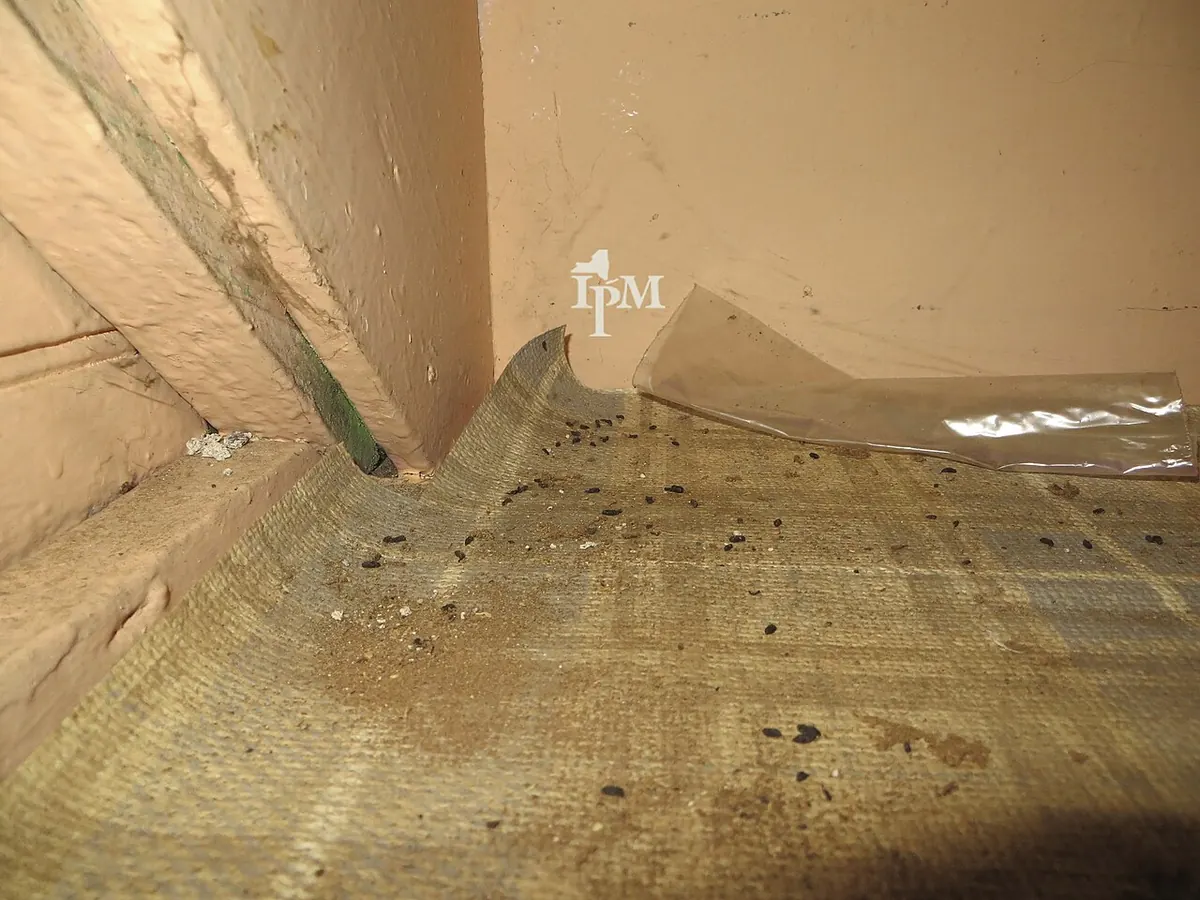
Rodents or insects. EPA lists ducts infested with vermin, such as rodents or insects, as a reason to clean. Our reasoning: cleaning before the pests are gone and their entry points are sealed just means cleaning twice.
Clogged ducts, or dust coming out of the supply registers. The key word is supply. Supply registers blow conditioned air into rooms. If you see particles actually being released from them, or the ducts are clogged with excessive dust and debris, cleaning is justified.
3. What is not a reason on its own
Dusty return grilles. EPA says it is normal for return registers to get dusty, because dust-laden air is pulled through the grate. That does not mean the ducts are heavily contaminated. Vacuum the grilles, or take them off and wash them.
A light layer of dust in the ducts. EPA says a light amount of household dust in air ducts is normal, and there is no evidence it poses any risk to your health.
"It has been a few years." No EPA schedule exists. EPA's guide goes further: don't hire duct cleaners who recommend duct cleaning as a routine part of your heating and cooling system maintenance.
No symptoms and nothing to see. EPA says that if no one in the household has allergies or unexplained symptoms, and a visual inspection shows no large deposits of dust or mold (no musty odor or visible mold), cleaning is probably unnecessary. If you do notice a musty smell, our guide on why your HVAC system smells and what each odor means can help you narrow down the cause before anyone sells you a cleaning.
4. How to check your own ducts
You don't need special tools for a first look. Turn the system off at the thermostat, then:
- Remove one supply register in a main room. Many are held by a couple of screws. Shine a flashlight into the duct. A thin, even film of dust is normal. Thick clumps, debris, droppings or fuzzy growth are not.
- Check a return grille near the furnace, where the duct is often largest. Again, look past the grille itself, which gets dusty by design.
- Look at the furnace or air handler. With the power off, check the filter slot. EPA's prevention advice starts here: make sure there are no missing filters and that air cannot bypass the filter through gaps around the filter holder.
- Run the fan and watch. Set the thermostat fan to On for a minute and look at a supply register in a dim room with a flashlight beam across it. A visible puff of dust is a real sign. A few specks are not.
5. The coupon problem: what state attorneys general found
Cheap duct cleaning offers are common, and state consumer protection offices have documented how some of them work.
- Washington, 2020. The Washington Attorney General's office reported that a court ruled two air duct companies broke state law. They made more than 13 million robocalls to more than a million Washington consumers. Their coupons advertised a $29 to $55 price without saying that only half of the heating and cooling system was included, and claimed a "regular" price of $150 to $225 that the companies never charged. With undisclosed limits and upselling, the special often ended up costing more than $1,000, and VIP memberships often cost around $1,200.
- Ohio, 2011. The Ohio Attorney General's consumer newsletter described a flyer for $49 duct cleaning, after which a representative cuts a hole in the duct and "discovers" a serious mold problem that will cost $2,000 to remove. Its advice: do a visual inspection yourself, and contact a microbiology lab to confirm mold.
- New Jersey, 2011. The New Jersey Attorney General's office took action over "Whole Duct House Cleaning" coupons priced from $37.95 to $69.95 that were allegedly used to bait buyers into higher-priced services. Its advice: get the total price in writing before the job starts.
A low price isn't proof of a scam. But if a technician finds an expensive problem you can't see, ask to see it, ask for it in writing, and don't sign that day.
6. If you do need cleaning: how to hire
EPA and NADCA, the National Air Duct Cleaners Association, give similar hiring advice. In short:
- Get at least three written estimates before deciding (EPA).
- Be wary of anyone who claims to be EPA certified. EPA says it does not establish duct cleaning standards and does not certify, endorse or approve duct cleaning companies.
- Ask about state licenses. EPA says to ask whether the company holds any relevant state licenses, and notes that some states require special licenses for duct cleaners. Ohio's attorney general noted that Ohio does not require one.
- Ask what is included. NADCA's homeowner's guide to HVAC system cleaning says to ask the contractor to specify which components will be cleaned, such as the supply and return ducts, coils, drains, registers and grills. EPA's guide notes that cleaning a system can include coils, drain pans, the fan and fan housing, and the air handler, not just the ducts.
- Ask how they control dust. NADCA says to make sure the contractor will limit the release of dust and debris into your home and use both agitation and vacuum collection. EPA says the vacuum should exhaust outside, or be HEPA-filtered if it exhausts inside the home.
- Ask about chemicals first. NADCA says the contractor should tell you if any chemicals will be used and provide a safety data sheet. EPA says to fully understand the pros and cons before allowing biocides or sealants, and notes that no biocides are registered for use on fiberglass duct board or fiberglass-lined ducts.
- Check NADCA membership if you want it. NADCA says members must have at least one certified Air Systems Cleaning Specialist on staff and carry general liability insurance. Ask for proof of insurance either way.
- Inspect the result. EPA's guide says all parts of the system should be visibly clean afterward, and suggests asking the company to show you each component when the job is done. Any access holes cut into ducts should be sealed and re-insulated so they are airtight.
EPA's 1997 guide put typical costs at $450 to $1,000 per system. That figure is decades old, so treat it as history, not a price guide.
7. How to keep ducts clean without cleaning them
EPA's prevention list is short and costs little:
- Use the right filter and change it. EPA says to use the highest efficiency filter recommended by your system's manufacturer, change filters regularly, and change them more often if they clog. If you're not sure, see our guide on how to tell if your furnace filter needs changing.
- Close the gaps. Make sure no filter is missing and that air cannot slip around the filter through gaps in the holder.
- Protect the system during renovation. During dusty construction or renovation, EPA says to seal off supply and return registers and not run the system until the dust is cleaned up.
- Control moisture. EPA calls controlling moisture the most effective way to prevent biological growth in ducts. Fix leaks and water damage, make sure the condensate pan drains, check insulation near the cooling coil for wet spots, and keep ducts in attics and crawl spaces sealed and insulated.
- Seal leaks with the right materials. ENERGY STAR's duct sealing guide says that in a typical house about 20 to 30 percent of the air moving through the ducts is lost to leaks, holes and poor connections. It recommends mastic sealant or metal tape and says never to use duct tape, because it doesn't last.
Ducts can have problems that have nothing to do with dirt. If yours bang or tick when the system starts, see why air ducts pop and which sounds need fixing.
When to call a pro
Call a heating and cooling contractor or a duct cleaning company if you find substantial visible mold, signs of rodents or insects in or near the ducts, or dust blowing from the supply registers. Call an HVAC contractor, not a duct cleaner, if duct insulation is wet or moldy, since it needs replacing. If you have a gas, oil or propane furnace, book its yearly inspection before the heating season whether or not you clean the ducts.
FAQ
How often should air ducts be cleaned?
There is no set schedule. EPA does not recommend cleaning air ducts routinely, only as needed, and says duct cleaning is not a necessary part of yearly maintenance. Clean them when you find substantial visible mold, rodents or insects, or ducts clogged with debris.
Does duct cleaning help with allergies or dust?
EPA says duct cleaning has never been shown to actually prevent health problems, and there is no evidence that a light amount of household dust in ducts poses a health risk. Regular filter changes, cleaning dust in the home and controlling moisture do more for most homes.
Are dusty return vents a sign my ducts need cleaning?
No. EPA says it is normal for return registers to get dusty as air is pulled through the grate, and it does not mean the ducts are heavily contaminated. Vacuum the grilles, or remove and wash them.
How much does duct cleaning cost?
EPA's guide gave a typical range of $450 to $1,000 per system, but that figure dates from 1997. Today's prices will differ, so get written estimates from at least three companies and ask exactly which parts are included.
Is a $49 duct cleaning coupon a scam?
Not always, but state attorneys general have taken action against companies that used cheap coupons as bait. In one Washington case, a $29 to $55 special covered only half the system and often ended up costing more than $1,000. Get the total price in writing before work starts.
Sources
| # | Source | Site |
|---|---|---|
| 1 | Should You Have the Air Ducts in Your Home Cleaned? (EPA 402-K-97-002), U.S. EPA | epa.gov |
| 2 | Should I have the air ducts in my home cleaned?, U.S. EPA | epa.gov |
| 3 | A Homeowner's Guide to HVAC System Cleaning, NADCA | nadca.com |
| 4 | AG Ferguson: Court rules Washington air duct companies engaged in unlawful robocalls, deceptive marketing, Washington State Attorney General (June 2020) | atg.wa.gov |
| 5 | Air duct cleaning: hype vs. science, Ohio Attorney General Consumer Advocate (September 2011) | ohioattorneygeneral.gov |
| 6 | Division of Consumer Affairs action against air duct cleaning companies, New Jersey Office of the Attorney General (April 2011) | nj.gov |
| 7 | Duct Sealing, ENERGY STAR | energystar.gov |
Every number above was checked against these sources. Found an error? See corrections or email contact@askabouthvac.com.

J.T. Bratcher
- License
- TACLB00138638E
- Type
- Texas Air Conditioning and Refrigeration Contractor License (Environmental, Class B)
- Status
- Current · expires April 11, 2027
- Checked
- October 18, 2026 via TDLR All Licenses dataset (data.texas.gov), license 138638
Related answers
- Du · Ducts & Airflow
Why Are My Air Ducts Popping? Normal Pings vs Sounds to Fix
Light pings when the heat starts or stops are normal duct expansion. A loud bang when the blower shuts off is oil-canning. What to check, and when to call a pro.
- Fu · Furnaces
Why Is My Furnace Filter Always Clean? 5 Reasons and What to Check
A furnace filter that stays clean usually means the system runs little, air is slipping around the filter, another filter is catching the dust first, or the filter is low efficiency. Here's how to check each one.
- Mt · Maintenance
How Long Does Refrigerant Last in an AC? Why It Shouldn't Run Out
Refrigerant in a home AC isn't used up. A sealed system should hold its charge for its whole life, so low refrigerant means a leak. What to ask your technician, and the 2026 rules for R-22 and R-410A owners.