Why Is My Furnace Filter Always Clean? 5 Reasons and What to Check
| Written by | Ask About HVAC Editorial Team | Expert review | ✓ J.T. Bratcher |
|---|---|---|---|
| Published | Last reviewed | ||
| Sources | 7 cited | Reading time | 6 min |
Quick answer
A furnace filter that always looks clean usually means one of five things: the system isn't running much, air is slipping around the filter instead of through it, another filter is catching the dust first, the filter is a low-efficiency type that lets fine dust pass, or your home simply has little dust right now. Only the first and last are harmless. Check the fit and look for a second filter before you decide the filter is just lasting well, and keep changing it on schedule either way.
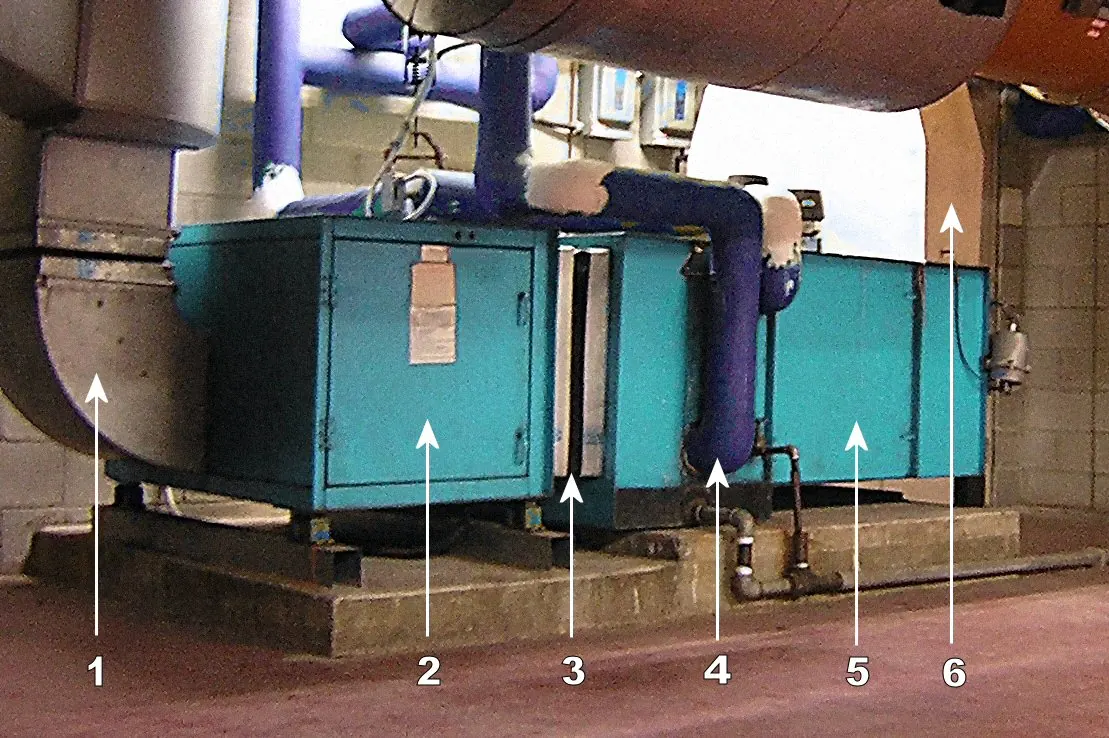
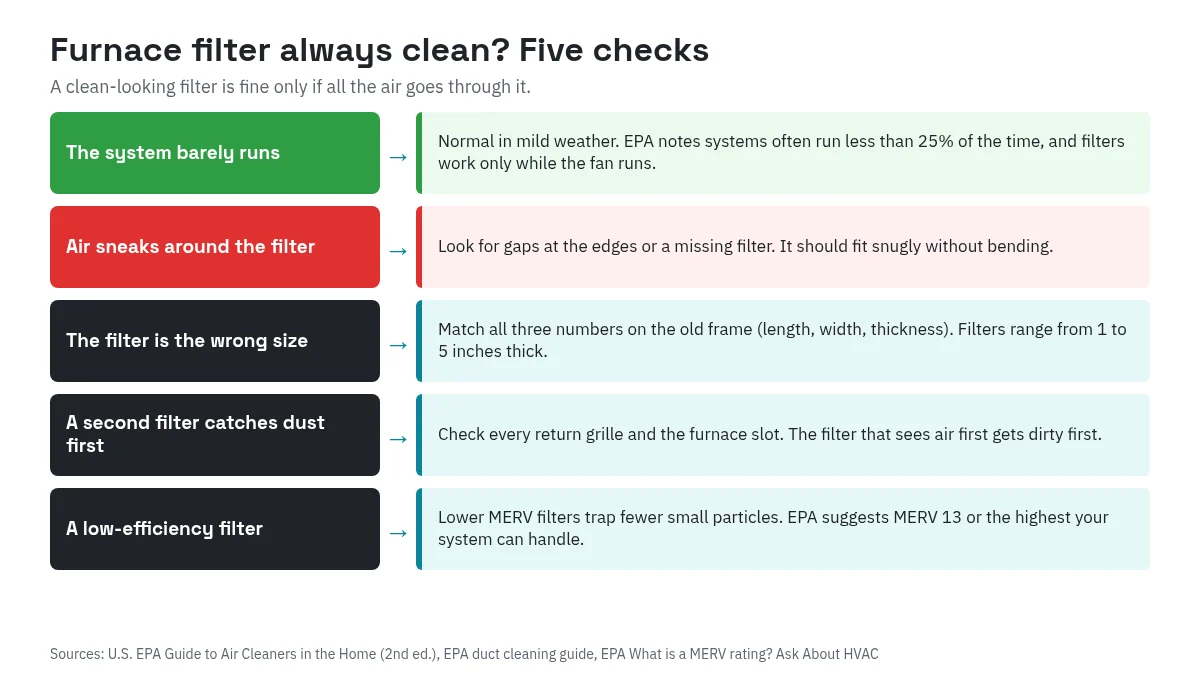
A filter only gets dirty from the air that actually passes through it. In the air handler pictured at the top of this page, the filter compartment sits on the return side, before the fan, so every bit of air the fan pulls in should go through it. When something breaks that path, the filter stays clean and the dust goes somewhere else.
1. The system barely runs
This is the most innocent reason. EPA's Guide to Air Cleaners in the Home says furnace and HVAC filters work to filter the air only when the system is operating. It adds that in most cases HVAC systems run only when heating or cooling is needed, usually less than 25 percent of the time during heating and cooling seasons. In spring and fall, when the system may hardly run at all, a filter can look the same for weeks.
What to check: look at how much the system has run since the last change. If it's been mild and the fan has been on Auto, a clean filter is expected.
Running the fan more moves more air through the filter. EPA says longer run times increase electricity costs and may also make humidity control less reliable during the cooling season. Our guide on whether your AC fan should be on or auto covers that trade-off in detail.
2. Air is slipping around the filter
This is the reason worth worrying about. If there's a gap around the edges, air takes the easy path and skips the filter. EPA says to make sure the filter fits snugly so air does not leak around it, and that you shouldn't have to bend or crush a filter to make it fit. In its duct cleaning guide, EPA's advice on preventing duct contamination also says to make sure no filters are missing and that air cannot bypass filters through gaps around the filter holder. EPA's guidance on HVAC filters and coronavirus says EPA, ASHRAE and CDC recommend checking filter fit to minimize filter air bypass.
What to check, with the system off:
- Look at the edges. Can you see daylight or a gap of any size between the filter frame and the slot or grille frame?
- Check the slot cover. Many furnaces have a cover or door over the filter slot. If it's missing or loose, the furnace can pull air in through that opening.
- Look for dust lines. A dark line of dust along the edge of the slot, or on the blower side of the filter frame, suggests air has been leaking past.
For a filter behind a return grille, the Building America Solution Center, run by Pacific Northwest National Laboratory for the U.S. Department of Energy, shows how to tape the edges of a return grille filter with masking tape to block air from bypassing around it, in a way that is easy to cut through at the next change.
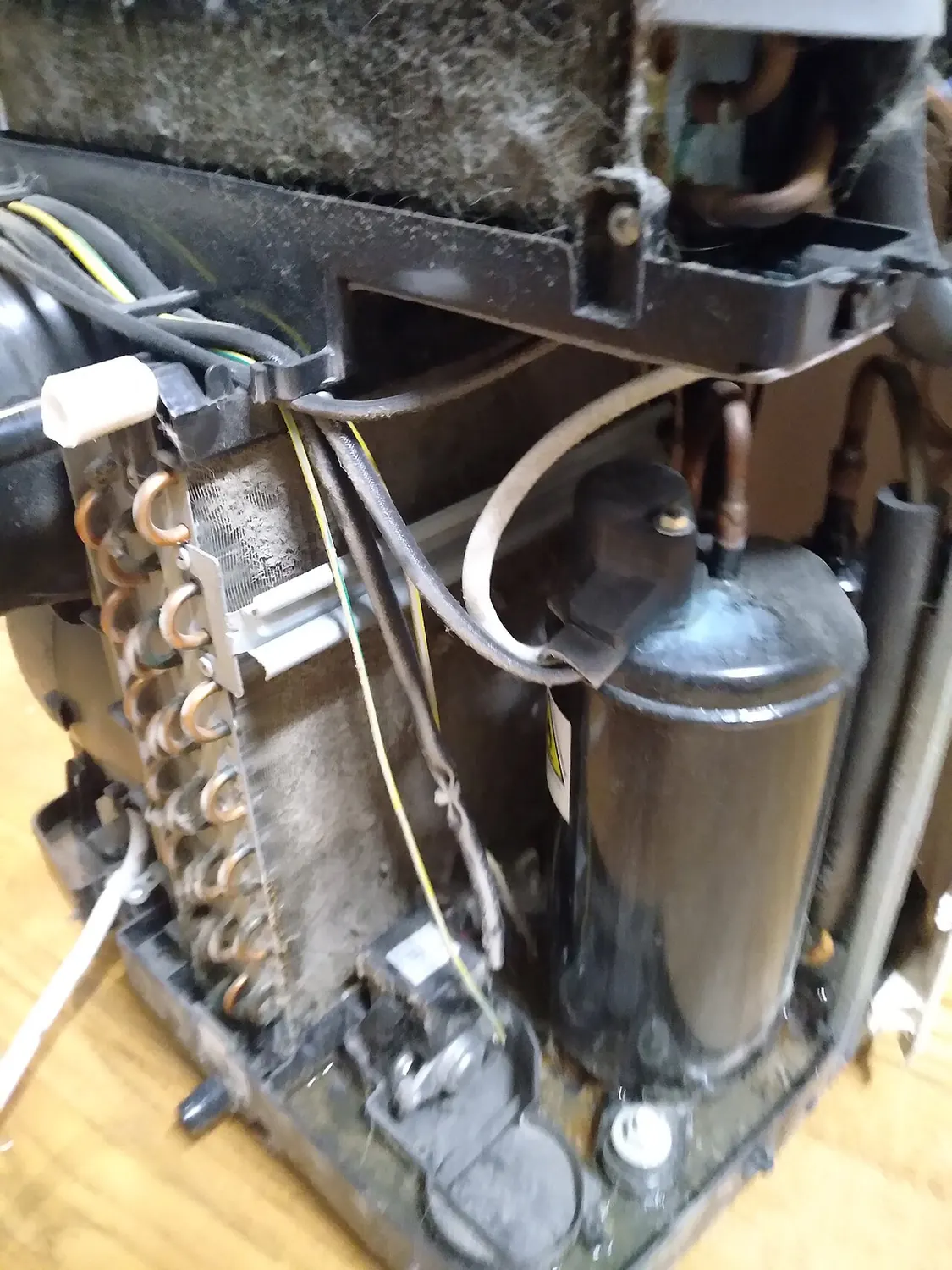
Why it matters: dust that skips the filter ends up on the blower, the coil and in the ducts. EPA's duct guide notes that cleaning dirty cooling coils, fans and heat exchangers can improve a system's efficiency, which tells you dirt on those parts is not harmless.
3. The filter is the wrong size
A filter that is a little too small in either direction leaves a gap, which is reason 2 by another name. EPA says filters commonly come in thicknesses of 1 to 5 inches, with a range of lengths and widths to match common filter frames. Our reasoning: a filter thinner than its slot may not seal at the edges.
What to check: read the three numbers printed on the old filter frame (length, width and thickness) and measure the slot itself if you can. The Building America guide says to replace a filter with one of the same length and width, and to measure the space to find the thickest filter it will accommodate.
While the filter is out, check the airflow arrow on its frame. If you're not sure which way it should point, see which way the furnace filter arrow goes.
4. Another filter is catching the dust first
Some homes have more than one filter, and the one you check may not be the one doing the work. The Building America guide says some homes have more than one return grille, for example one on each floor, and each may have a filter installed. It also says a filter may sit in a slot at the furnace cabinet between the return plenum and the furnace. Trane's guide to finding your air filter adds that some systems have a return in each room, so there may be a filter behind each of those return grilles.
What to check: walk the house and open every large return grille. Then look at the furnace or air handler for a filter slot or a thicker filter cabinet near where the return duct connects. If there's a dirty filter at a grille and a clean one at the furnace, the grille filter is catching the dust first. Change every filter you find on its own schedule.
5. The filter catches less than you think
A low-efficiency filter can stay looking clean because it lets much of the fine dust through. EPA's page on what a MERV rating means says MERV reports a filter's ability to capture particles between 0.3 and 10 microns, and the higher the MERV rating, the better the filter is at trapping specific sizes of particles. EPA suggests at least MERV 13, or as high a rating as your system fan and filter slot can accommodate, and says most furnaces and HVAC systems can take a MERV 13 filter without equipment problems, provided it is replaced frequently.
Because MERV is measured on particles as small as 0.3 microns, how a filter looks is only a rough guide to what it's catching. Some pages suggest buying a lower-MERV filter when one stays clean. We don't agree: a clean-looking filter is not a reason to filter less.
It could just be a clean house
Homes differ in how much dust they produce, so a filter can simply last longer in one home than in another. That's fine, as long as you've ruled out reasons 2 to 4. What it doesn't change is the schedule.
Keep changing it on schedule
A filter that looks clean still gets changed. EPA says manufacturers typically recommend replacing filters every 60 to 90 days, and to consider changing them more often if they look heavily soiled when you replace them. EPA also notes that many factors can affect how quickly filters get dirty. ENERGY STAR's maintenance checklist says to inspect, clean or change filters once a month in your furnace, central air conditioner or heat pump, and warns that a dirty filter can increase energy costs and damage equipment. Follow the change interval on your filter's packaging or in your furnace manual. For the visual and airflow signs that a filter is due, see how to tell if your furnace filter needs changing.
If dust is building up on your registers or furniture even though the filter stays clean, that points back to bypass or a second filter. It's not automatically a reason to clean the ducts. Our guide on whether ductwork needs to be cleaned explains what EPA says does and doesn't justify it.
When to call a pro
Call an HVAC technician if the filter slot has no cover and you can't find a matching one, if the filter frame or rack is bent so no filter fits snugly, if you find dust building up inside the blower compartment, or if a filter that is the right size still leaves a gap. A technician can also tell you the highest MERV rating your system fan and filter slot can handle.
FAQ
Is it bad if my furnace filter is always clean?
Not always. In mild weather the system may run very little, and EPA notes that furnace filters only filter air while the system is operating. But a filter that never collects dust can also mean air is slipping around it, or another filter is catching the dust first, so it is worth checking the fit and looking for other filters.
Should I still change a furnace filter that looks clean?
Yes, on schedule. EPA says manufacturers typically recommend replacing filters every 60 to 90 days, and ENERGY STAR says to inspect, clean or change filters once a month. How a filter looks is only a rough guide to what it is catching.
Can a furnace have more than one filter?
Yes. The U.S. Department of Energy's Building America Solution Center says some homes have more than one return grille, such as one on each floor, and each may have a filter. A filter can also sit in a slot at the furnace. Our reasoning: the first filter the air reaches will catch most of the dust, so a second filter further along can stay clean.
Should I switch to a cheaper, lower MERV filter if mine stays clean?
We don't recommend that as a fix. EPA says the higher the MERV rating, the better the filter traps particles, and suggests MERV 13 or the highest rating your system fan and filter slot can accommodate. A clean-looking filter is not a reason to filter less.
Will running the fan on ON make the filter get dirty faster?
It moves more air through the filter, so it filters more. EPA notes that longer run times increase electricity costs and may make humidity control less reliable in the cooling season, so weigh that trade-off first.
Sources
| # | Source | Site |
|---|---|---|
| 1 | Guide to Air Cleaners in the Home, 2nd edition (2018), U.S. EPA | epa.gov |
| 2 | What is a MERV rating?, U.S. EPA | epa.gov |
| 3 | Air Cleaners, HVAC Filters, and Coronavirus (COVID-19), U.S. EPA | epa.gov |
| 4 | Should You Have the Air Ducts in Your Home Cleaned?, U.S. EPA | epa.gov |
| 5 | Replace Air Filter Located at Return Air Filter Grille, Building America Solution Center (PNNL, U.S. DOE) | basc.pnnl.gov |
| 6 | Where is the Air Filter in My HVAC System?, Trane | trane.com |
| 7 | Maintenance Checklist, ENERGY STAR | energystar.gov |
Every number above was checked against these sources. Found an error? See corrections or email contact@askabouthvac.com.

J.T. Bratcher
- License
- TACLB00138638E
- Type
- Texas Air Conditioning and Refrigeration Contractor License (Environmental, Class B)
- Status
- Current · expires April 11, 2027
- Checked
- October 18, 2026 via TDLR All Licenses dataset (data.texas.gov), license 138638
Related answers
- Fu · Furnaces
Why Does My Furnace Filter Collapse? 5 Causes and How to Stop It
A furnace filter folds or bows when more air pushes on it than its frame can take: a filter loaded with dust, the wrong size, a thin 1-inch filter on a big blower, or a denser filter than the system was built for. Here is how to tell which one and fix it.
- Fu · Furnaces
How to Tell If Your Furnace Filter Needs Changing: 5 Checks
Pull the filter and hold it up to a light: if you can't see light through it, replace it. Also change it if it's wet, damaged or past the maker's interval (about 3 months for 1-inch pleated filters). Here are the checks and the warning signs from the system.
- Fu · Furnaces
Furnace Filter Put In Backwards? Which Way the Arrow Goes and What to Do
The airflow arrow on a furnace filter points toward the blower, away from the return duct. If yours is in backwards, turn the system off and flip it. Here is how to find the right direction when the arrow is missing or hard to read.