How Long Does Refrigerant Last in an AC? Why It Shouldn't Run Out
| Written by | Ask About HVAC Editorial Team | Expert review | ✓ J.T. Bratcher |
|---|---|---|---|
| Published | Last reviewed | ||
| Sources | 9 cited | Reading time | 5 min |
Quick answer
Refrigerant in a home air conditioner should last as long as the system itself. It moves around a sealed loop and is not used up, so a properly installed system that is low on refrigerant has a leak. The fix is to have a certified technician find and repair the leak, not to "top it off" every summer.
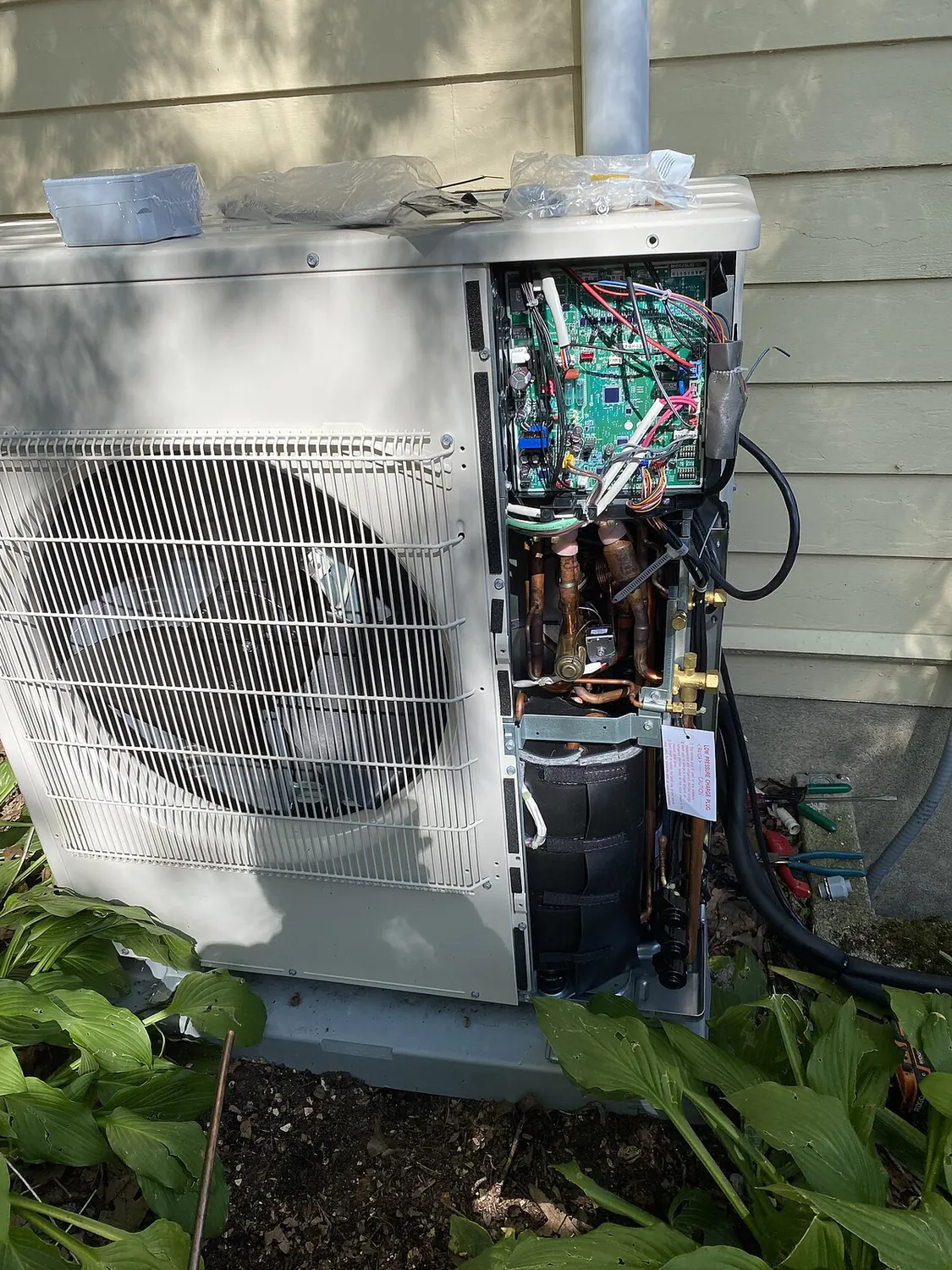
Why refrigerant doesn't wear out
Trane calls refrigerant the lifeblood of an AC system: during the cooling cycle it moves through the system, changing from a liquid to a gas as it carries heat out of your home (Trane AC refrigerant leak guide). It is reused over and over, not burned like fuel.
So a low charge has one cause. Trane says the only reason a heat pump would have low refrigerant is a leak, and our reasoning is that the same applies to central AC, which uses the same kind of sealed loop. EPA adds that major leaks rarely develop in properly installed and regularly maintained units (EPA homeowner refrigerant FAQ).
The equipment around the refrigerant does wear out. The Department of Energy lists a life span of 15 to 20 years for central air conditioners, 12 to 15 years for ductless mini-splits and 10 to 15 years for room units (DOE Energy Saver 101: Home Cooling). Our reasoning: if nothing leaks, the original charge should last that long too.

Why leaks happen
Trane lists the common causes of refrigerant leaks as wear and tear, corrosion, physical damage, a frozen evaporator coil and improper installation. A trained technician can find the leak and tell you what caused it.
Our guide to the signs of an AC refrigerant leak covers the clues in detail. In short, Trane names warm air from the vents, higher humidity with the AC on, uneven cooling and higher bills, and says a hissing sound near the refrigerant lines likely means a leak. Some refrigerants, such as R-22, can give off a faint, slightly sweet smell. Lennox adds that leaks can cause ice on the coils (Lennox refrigerant leak guide).
Don't keep running it, and don't just top it off
Trane says running the air conditioner with a refrigerant leak can do further damage. Lennox says operating with a low charge strains the compressor and risks major damage, that only licensed professionals should test and repair leaks, and to turn the system off if you suspect a leak.
When you call, ask for a repair, not a refill. EPA says that if your air conditioner leaks, you should ask your technician to locate and repair the leak instead of "topping it off," which keeps the system running at its best and cuts refrigerant emissions and energy use. EPA also says it is illegal to intentionally release refrigerant while servicing AC equipment.
One thing many owners don't know: EPA requires leaks above a certain size to be repaired only in equipment that contains 50 pounds of refrigerant or more (EPA venting prohibition). If your system holds less than that (ask your technician), that rule won't force a repair. So it is up to you to ask for the leak to be fixed rather than refilled year after year.
Can you add refrigerant yourself?
No. EPA says Section 608 certification is required to recharge appliances, and refrigerant for stationary appliances is only sold to certified technicians or the companies that employ them. EPA says the same certification is needed even to add or remove refrigerant when installing a mini-split.
Watch for "R-22a." EPA says it has been falsely marketed as R-22 or an R-22 replacement, but it is a highly flammable hydrocarbon refrigerant that is not acceptable for home AC, and it can burn or explode because R-22 systems have no safety features for flammable refrigerants.
Which refrigerant does your AC use?
Check the nameplate. EPA says the refrigerant is usually listed on the unit's nameplate, which for central AC is usually on the outdoor condenser. If there is no nameplate, check the owner's manual.
If you have R-22 (often called Freon)
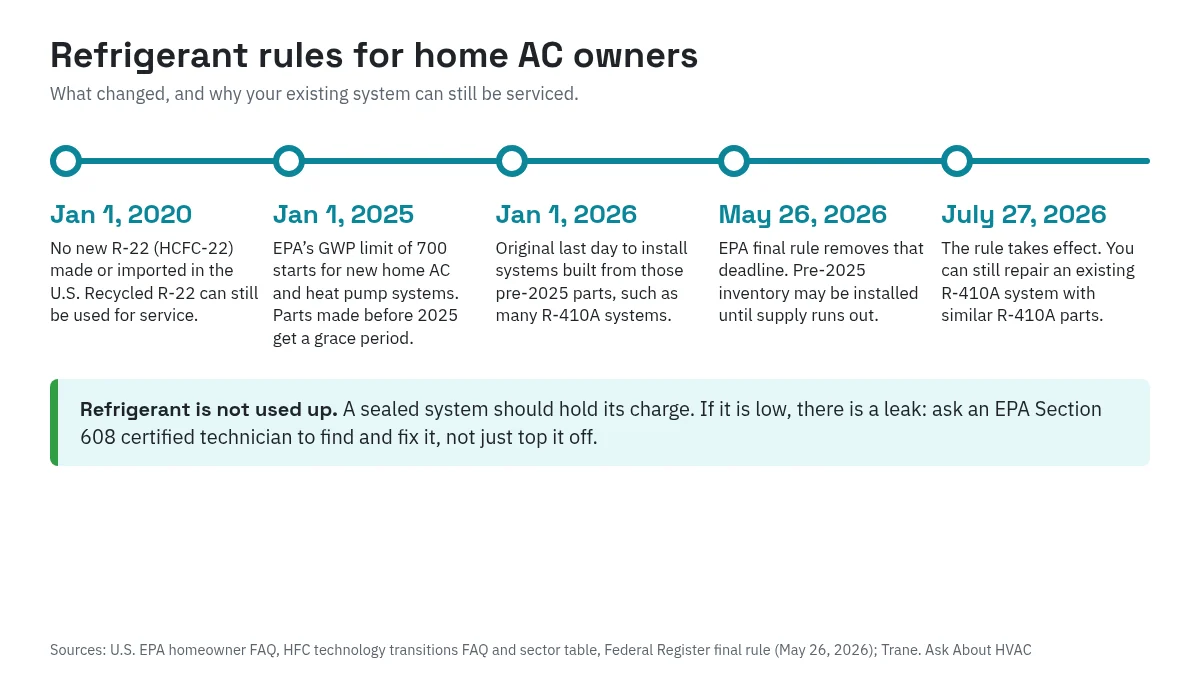
EPA does not require you to replace a working R-22 system. As of January 1, 2020, no new R-22 is made or imported in the U.S., but used R-22 that is cleaned to the same standard as new refrigerant can still be used to service systems. EPA also says there are no "drop in" replacements for R-22, and that switching an old system to another refrigerant needs a certified technician to recover the remaining R-22 first. Our reasoning: because new R-22 is no longer made, a big leak on an old R-22 system is a good time to weigh repair against replacement.
If you have R-410A
You can keep it and repair it. EPA says homeowners can maintain and repair their systems throughout the useful life of the equipment, and can replace a faulty part, such as a condensing unit or indoor coil, with a similar R-410A part (EPA HFC phasedown FAQ). The rules apply to new systems. EPA counts it as a new system when one goes into a newly built home, or when both the condensing unit and indoor coil are replaced.
Here is how the rules for new systems changed. Starting January 1, 2025, EPA set a global warming potential (GWP) limit of 700 for new home and light commercial AC and heat pump systems, with no installation deadline for systems whose parts were all made or imported before that date (EPA HFC restrictions by sector). An earlier rule had set January 1, 2026 as the last day to install that older equipment. EPA's May 2026 final rule removed that January 1, 2026 installation date and allows pre-2025 inventory to be installed until supply runs out (EPA final rule fact sheet). The rule was published May 26, 2026 and took effect July 27, 2026 (Federal Register final rule).
If you are pricing a new system, our guide to what a good SEER rating is in 2026 explains the efficiency side.
How to keep the charge you have
- Book regular maintenance. Lennox says regular tune-ups help catch leaks early. EPA says the most important step is to maintain your unit properly.
- Fix leaks early. EPA says repairing leaks keeps the system working at its best and can save money by avoiding more repairs later.
- Get older systems checked. EPA recommends having equipment more than 10 years old, or any system that isn't keeping you comfortable, evaluated by a professional HVAC contractor.
If you have a heat pump that has stopped heating or cooling, start with our checklist on why your heat pump is not working before assuming it is a refrigerant problem.
FAQ
Does AC refrigerant need to be replaced every year?
No. Refrigerant circulates in a sealed loop and is not burned up or used up. If your system needs refrigerant added, it has a leak. EPA asks homeowners to have technicians locate and repair leaks instead of topping them off.
Can I add refrigerant to my home AC myself?
No. EPA says Section 608 certification is required to recharge appliances, and refrigerant for stationary systems is only sold to certified technicians or the companies that employ them.
Do I have to replace my R-22 air conditioner?
No. EPA does not require homeowners to replace existing equipment. New R-22 has not been made or imported in the U.S. since January 1, 2020, but cleaned, recycled R-22 can still be used for service.
Do I have to replace my R-410A system in 2026?
No. EPA says homeowners can maintain and repair R-410A systems for the useful life of the equipment, including replacing a faulty part with a similar R-410A part. The rules apply to new systems.
Is R-22a the same as R-22?
No. EPA says R-22a has been falsely marketed as R-22 or a replacement, but it is a highly flammable hydrocarbon refrigerant that is not acceptable for home AC systems.
Sources
| # | Source | Site |
|---|---|---|
| 1 | Homeowners and Consumers: Frequently Asked Questions, U.S. EPA (last updated April 1, 2026) | epa.gov |
| 2 | Frequent Questions on the Phasedown of Hydrofluorocarbons, U.S. EPA (last updated September 14, 2026) | epa.gov |
| 3 | Technology Transitions HFC Restrictions by Sector, U.S. EPA (last updated August 28, 2026) | epa.gov |
| 4 | Fact Sheet: Final Rule, Phasedown of Hydrofluorocarbons, Reconsideration of Certain Technology Transitions Requirements, U.S. EPA (May 2026) | epa.gov |
| 5 | Phasedown of Hydrofluorocarbons: Reconsideration of Certain Regulatory Requirements (final rule), Federal Register, May 26, 2026 | federalregister.gov |
| 6 | Stationary Refrigeration: Prohibition on Venting Refrigerants, U.S. EPA | epa.gov |
| 7 | AC Refrigerant Leaks: Leak Detection and Repair, Trane | trane.com |
| 8 | How to Identify an AC Refrigerant Leak, Lennox (Aug 30, 2024) | lennox.com |
| 9 | Energy Saver 101: Home Cooling, U.S. Department of Energy | energy.gov |
Every number above was checked against these sources. Found an error? See corrections or email contact@askabouthvac.com.

J.T. Bratcher
- License
- TACLB00138638E
- Type
- Texas Air Conditioning and Refrigeration Contractor License (Environmental, Class B)
- Status
- Current · expires April 11, 2027
- Checked
- October 18, 2026 via TDLR All Licenses dataset (data.texas.gov), license 138638
Related answers
- Du · Ducts & Airflow
Does Ductwork Need to Be Cleaned? When It Helps and When It's a Sales Pitch
EPA does not recommend routine duct cleaning. It makes sense for substantial visible mold, rodents or insects, or ducts clogged with debris. Here's how to check, what to skip and how to hire safely.
- Fu · Furnaces
Why Is My Furnace Filter Always Clean? 5 Reasons and What to Check
A furnace filter that stays clean usually means the system runs little, air is slipping around the filter, another filter is catching the dust first, or the filter is low efficiency. Here's how to check each one.
- Hp · Heat Pumps
Why Is My Heat Pump Not Working? 6 Symptoms and What to Check
Most heat pump problems start with a thermostat setting, a switch, a breaker, a dirty filter or a normal defrost cycle. Match your symptom, do the safe checks from the makers' guides, and know when to call a pro.