How to Choose an Air Filter for Your Home: Size, MERV and What Your System Can Handle
| Written by | Ask About HVAC Editorial Team | Expert review | ✓ J.T. Bratcher |
|---|---|---|---|
| Published | Last reviewed | ||
| Sources | 10 cited | Reading time | 9 min |
Quick answer
Start with the size printed on the frame of the filter you are replacing, then buy the highest MERV rating your system's fan and filter slot can accommodate. For most homes that means a pleated MERV 13 filter, the level EPA suggests when you upgrade. If your system has only ever had a flimsy 1-inch fiberglass filter, ask an HVAC technician before you jump straight to MERV 13, and plan to change the new filter more often at first. Skip anything that adds ozone, and if you need odor or smoke control in one room, a portable air cleaner may do more than the furnace filter can.
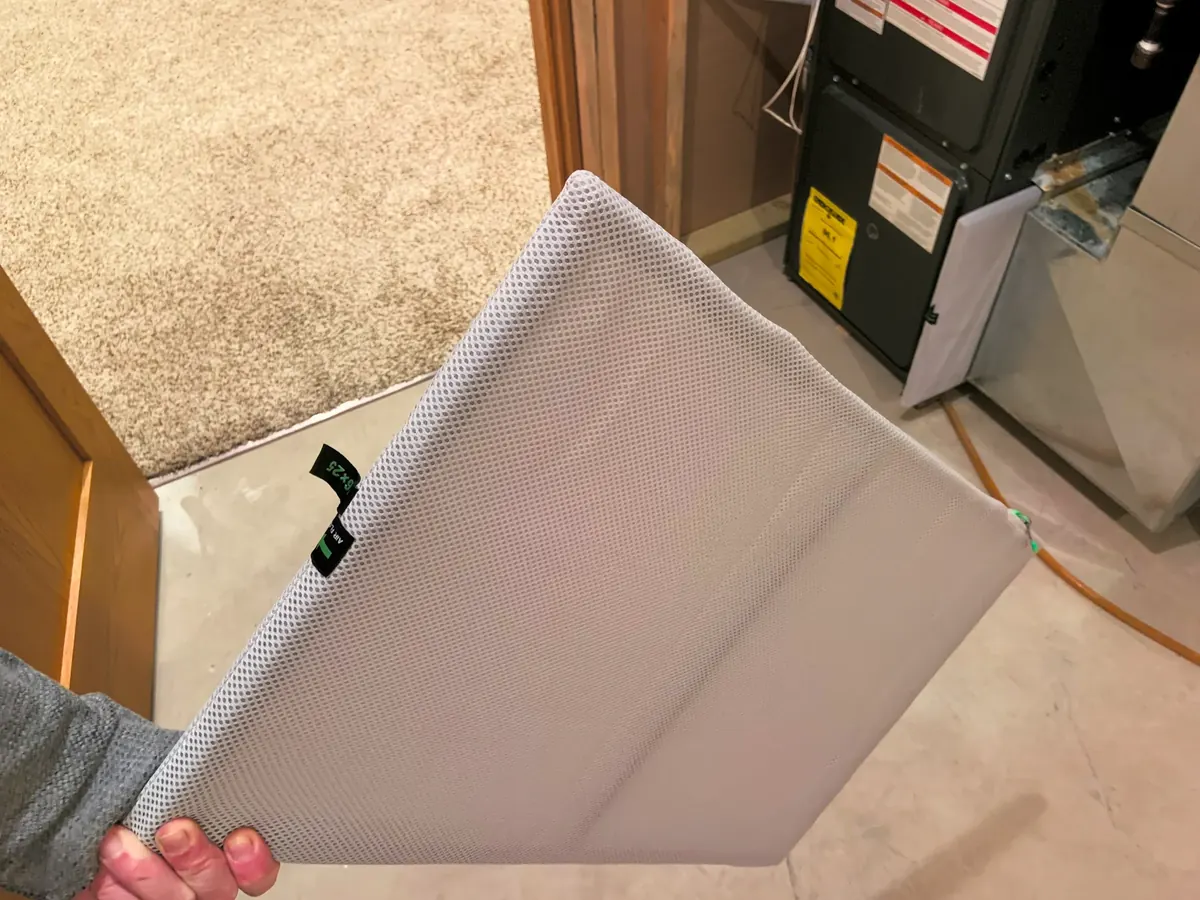
Three numbers decide the purchase: the dimensions, the depth and the MERV. Everything else on the package (brand scores, "allergen" labels, color-coded tiers) is marketing layered on top of those three.
Step 1: Get the size exactly right
A filter that leaks around its edges is a filter that isn't working, no matter what rating it carries.
- Read the old frame. It lists length, width and thickness, for example 16 x 25 x 1. That is the nominal size, a rounded label. The Building America Solution Center's filter replacement guide tells shoppers to look at the actual dimensions of the filter, not just the nominal size, because the real frame is usually a bit smaller than the label.
- Measure the slot, not just the old filter. If a previous owner squeezed in the wrong size, copying it repeats the mistake. The same DOE guide says to measure the filter space and install the thickest filter that the space can accommodate.
- Expect 1 to 5 inches of depth. EPA notes filters commonly come in thicknesses of 1 to 5 inches. A furnace with a deep media cabinet takes a thick filter; a return grille in a hallway ceiling usually takes a 1-inch one.
- No bending, no gaps. EPA's guide says the filter should fit snugly so air does not leak around it, and you should not have to bend or crush it to make it fit. At a return grille, DOE's guide suggests running masking tape around the perimeter to stop air from slipping past.
If you're not sure which way the arrow points once you have the right size, see which way a furnace filter goes and what happens if it's backwards.
Step 2: Pick the MERV rating
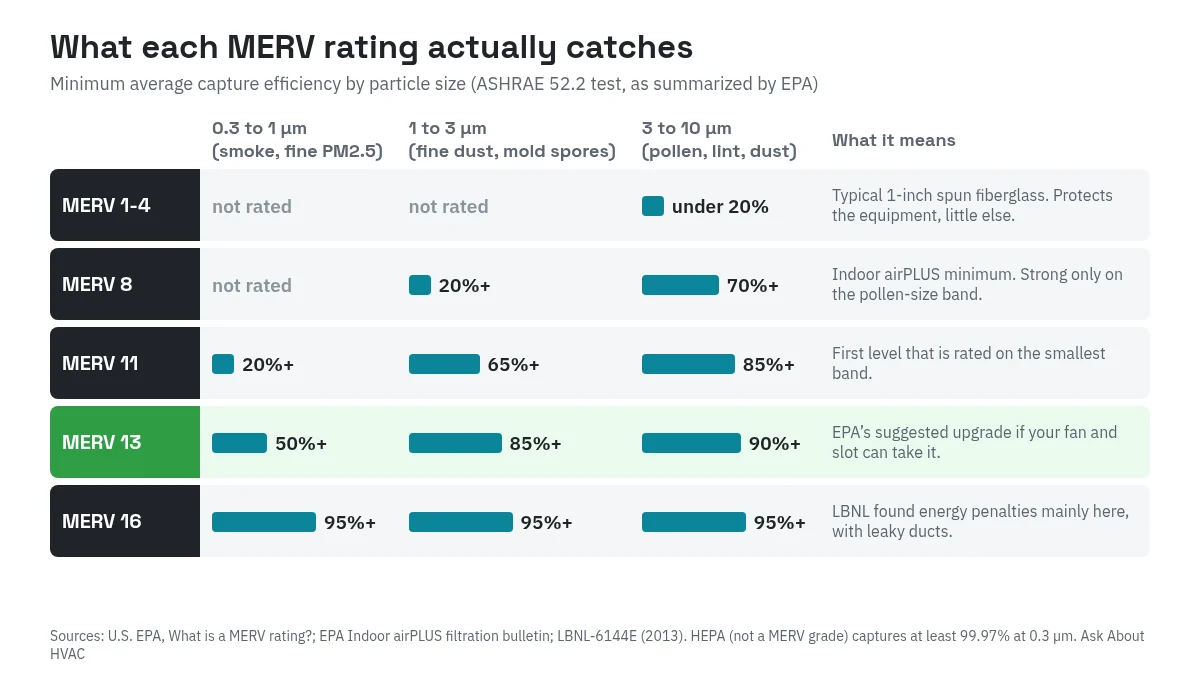
MERV (Minimum Efficiency Reporting Value) reports how well a filter captures particles between 0.3 and 10 microns, measured with the ASHRAE 52.2 test. Higher numbers trap more of the small stuff. EPA's MERV explainer gives its advice in one line: if you upgrade, choose a filter with at least a MERV 13 rating, or as high a rating as your system fan and filter slot can accommodate.
What the common grades mean in practice:
- MERV 1 to 4. EPA's Indoor airPLUS filtration bulletin describes the typical 1-inch spun fiberglass furnace filter as MERV 1 to 4. The bulletin says it can trap particles like sawdust, carpet fibers, dust mites and pollen.
- MERV 8. The minimum filter for Indoor airPLUS certified homes. EPA's table rates it on the 1 to 3 micron band but not on the smallest one.
- MERV 11. EPA's bulletin says it removes roughly 20% of particles between 0.3 and 1 micron.
- MERV 13. Must show at least 50% removal of the smallest particles tested. This is the grade EPA points to for wildfire smoke and fine particles.
- MERV 14 to 16. Higher capture again, but this is the range where the airflow trade-offs in the next step become real.
You'll also see FPR and MPR numbers on store shelves. EPA's Guide to Air Cleaners in the Home points out that MERV is based on a national consensus standard while the FPR and MPR rating methods are proprietary. Compare brands on MERV and ignore the rest.
Our take: for a household that mainly wants dust under control, with no smokers, allergies or wildfire exposure, a MERV 8 to 11 pleated filter changed on time is a reasonable middle ground. When anyone in the home has asthma, or smoke blows in from wildfires, MERV 13 is where the filter starts doing meaningful work on fine particles.
Step 3: Make sure your system can handle it
This is the question most filter shoppers argue about online, and there is good data on it.
What EPA says. Most furnaces and HVAC systems can accommodate a MERV 13 filter without creating equipment problems, provided that the filter is replaced frequently. EPA also admits the catch: systems are not commonly labeled with any filter recommendation, so the only way to be certain is to have a technician check.
What DOE's field guidance adds. The Building America Solution Center's high-MERV filter guide says that filters with deeper or more numerous pleats tend to have lower pressure drop, and that a filter with 4-inch-deep pleats has twice the surface area of one with 2-inch pleats. That's the case for using a 4-inch media cabinet if your furnace has one, rather than the thinnest slot in the house. Depth is not magic, though: a study reviewed in the LBNL report found that going from 1 to 2 inches, or 2 to 4 inches, deep had only a marginal effect on the pressure drop of clean filters. The same report cites research finding that pressure drop was not highly correlated with MERV rating, so two filters with the same MERV can load a blower differently. The DOE replacement guide also warns that higher MERV filters can clog more quickly, and tells homeowners to check with their HVAC service company before switching from a MERV 1 to a MERV 13 or higher.
What the energy data shows. Lawrence Berkeley National Laboratory monitored filters in occupied homes in several California climates, then used those measurements in simulations covering a wider range of climates (LBNL-6144E). The researchers found the effects of filtration on energy use were about 1% or less, averaged over all climates and loading situations, with one exception: MERV 16 filters with leaky ducts and a variable-speed (BPM) blower motor. Their first recommendation was that no energy related requirements are needed for MERV 11 or lower filters. The field tests also showed that system static pressures were highly influenced by filter selection, and the report notes that filter pressure drop increases as filters become dirty. An overdue filter is part of the airflow problem, whatever its rating.
The practical reading of all three sources:
- MERV 13 in a 4- or 5-inch media cabinet is the easy case.
- MERV 13 in a 1-inch slot usually works, but check it after the first month and expect shorter change intervals.
- MERV 14 to 16 is a job for a technician who measures static pressure, not a shelf decision. EPA's Indoor airPLUS bulletin tells builders to use ACCA Manual D to find the maximum static pressure the filter can have before choosing one.
If a filter bows or folds in its slot, read why furnace filters collapse and how to stop it.
What a central filter can't do
Even a perfect filter has limits, and knowing them saves money on the wrong upgrades.
- It only works when the fan runs. EPA notes that HVAC systems usually run less than 25% of the time during heating and cooling seasons. In mild weather the filter sits idle most of the day.
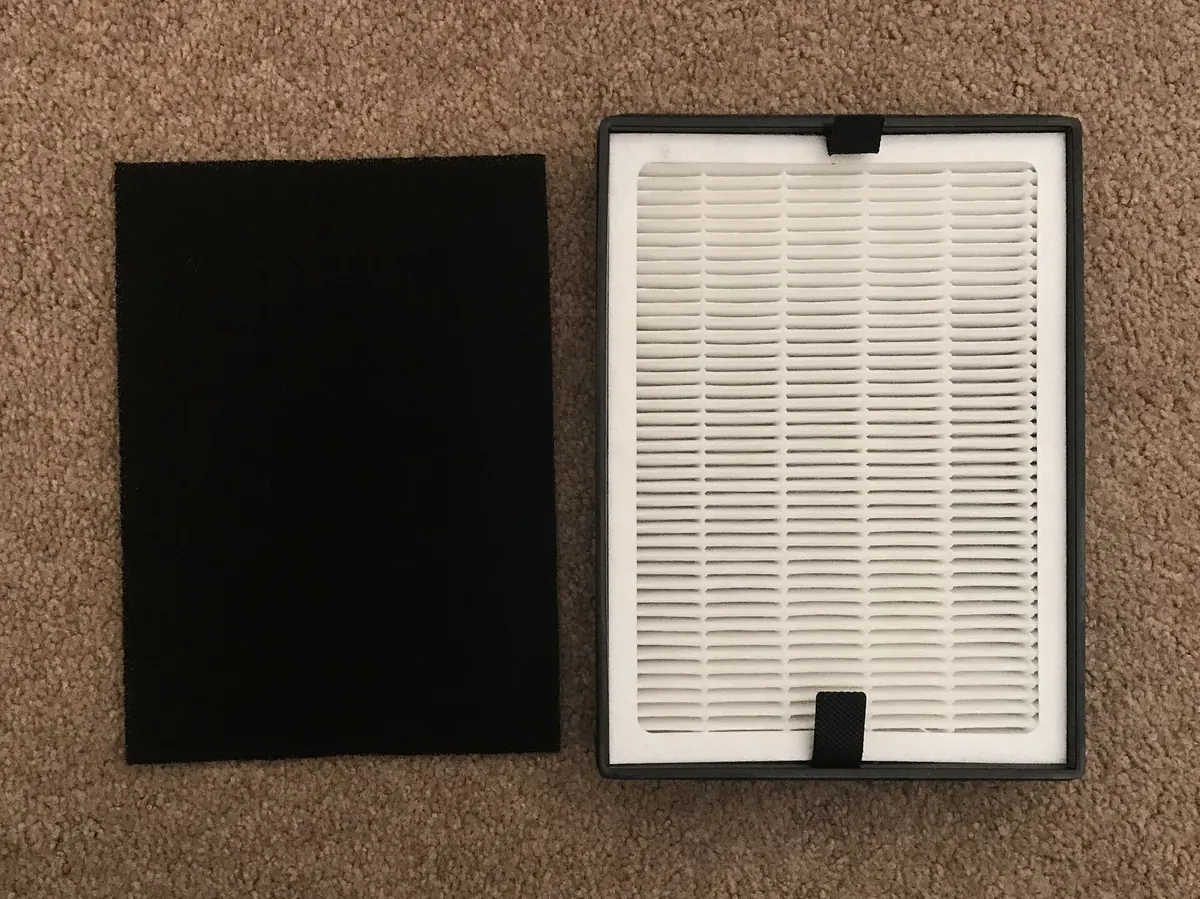
- It doesn't remove gases. The CADR and MERV systems are for particles. EPA's guide says that to filter gases you need an activated carbon filter or another filter designed to remove gases, and that carbon filters can be effective provided there is a large amount of material in the filter. A 1-inch furnace filter with a light carbon layer holds far less material than a dedicated carbon bed, so treat odor claims on those packages with caution.
- It doesn't fix mold. EPA states that portable air cleaners and furnace filters do not address the cause of mold and musty odors; the fix is to remove the moisture source and clean up the mold. If your house has a damp smell in summer, check whether your dehumidifier has stopped working before you shop for filters.
- Window units and ductless heads aren't air cleaners. EPA says most window and wall-mounted units have limited filtration intended to keep the inside of the air conditioner clean rather than remove fine particles from indoor air.
Skip anything that makes ozone
Some "air purifying" filters and add-ons work by charging particles or generating ozone. EPA's page on ozone generators sold as air cleaners is blunt: no agency of the federal government has approved these devices for use in occupied spaces, and when inhaled, ozone can damage the lungs. The same page notes that in experiments, ionizers were less effective at removing dust, smoke, pollen or fungal spores than high efficiency particle filters or electrostatic precipitators.
The risk isn't limited to products labeled "ozone generator." EPA's air cleaner guide warns that electrostatic precipitators, ionizers, UV lights without adequate lamp coatings and plasma air cleaners may have the potential to emit ozone. Two lists help:
- California's certification list. The California Air Resources Board requires all indoor air cleaners sold in California to be certified, including those sold online. Its list is a useful screen even if you live elsewhere.
- AHAM's list. EPA's guide notes that both CARB and the Association of Home Appliance Manufacturers maintain lists of air cleaners that have been tested and shown to emit little or no ozone.
One more label to read carefully: EPA says an ENERGY STAR label on an air cleaner means it meets efficiency guidelines and does not refer to its air-cleaning effectiveness in any way.
When a portable air cleaner is the better buy
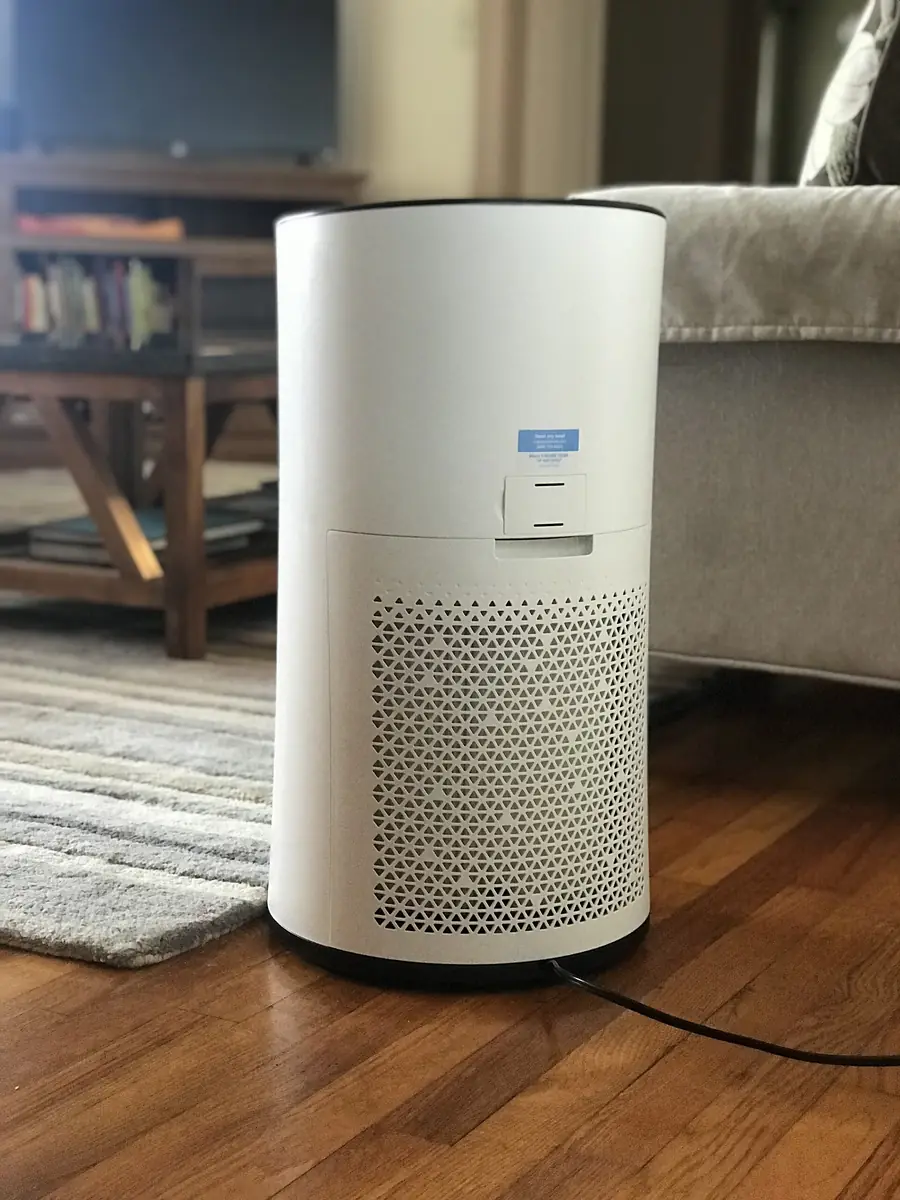
If the goal is cleaner air in a bedroom or a nursery, a room unit often beats any furnace upgrade, because it runs where you are and doesn't depend on heating or cooling demand.
HEPA, the filter type most room units use, is defined by DOE and captures at least 99.97% of particles at 0.3 microns, which EPA describes as the most penetrating particle size. Larger and smaller particles are trapped with even higher efficiency.
Size the unit by its clean air delivery rate (CADR). EPA's guide gives this minimum for particle removal, based on an 8-foot ceiling:
| Room area | Minimum CADR |
|---|---|
| 100 sq ft | 65 cfm |
| 200 sq ft | 130 cfm |
| 300 sq ft | 195 cfm |
| 400 sq ft | 260 cfm |
| 500 sq ft | 325 cfm |
| 600 sq ft | 390 cfm |
Pick from the tobacco smoke CADR when the box lists three, since EPA says it represents the smallest particles. EPA's guide adds that rooms with ceilings above 8 feet call for a unit sized for a larger area. For noise, EPA offers a reference point: about 50 decibels is roughly the sound of a modern refrigerator.
During wildfire smoke, EPA's wildfire and indoor air guidance says to consider upgrading to a MERV 13 or higher filter if your system can accommodate it, and to set a central system with a fresh air intake to recirculate. EPA also describes do-it-yourself air cleaners made by attaching furnace filters to a box fan, while noting that commercial units with a known CADR are typically preferred.
Set the change schedule when you buy
EPA says manufacturers typically recommend replacement every 60 to 90 days, and that heavily soiled filters at change time mean you should change them more often. Higher MERV filters fill faster, so the first replacement is the one to watch. Write the size and the date on the new frame. For the checks that tell you it's time, see how to tell if your furnace filter needs changing.
When to call a pro
Call an HVAC technician if you want MERV 14 or higher, if the only slot is a 1-inch return grille and airflow already seems weak, or if the filter keeps bowing or clogging within weeks. A technician can measure static pressure across the filter and, as EPA notes, can modify the system to use a higher efficiency filter. DOE's high-MERV guide describes one common approach: modifying the return ductwork near the air handler or furnace to increase filter surface area.
FAQ
Is MERV 13 too high for a home furnace?
Usually not. EPA's Guide to Air Cleaners in the Home says most furnaces and HVAC systems can accommodate a MERV 13 filter without creating equipment problems, provided the filter is replaced frequently. Because systems are rarely labeled with a filter limit, have an HVAC technician confirm it if you are jumping from a basic fiberglass filter.
Are 4-inch filters better than 1-inch filters?
If your cabinet has a 4-inch slot, use it. The Building America Solution Center says deeper pleats add surface area, which lowers pressure drop at the same MERV, and a 4-inch-deep pleat has twice the surface area of a 2-inch pleat. You cannot force a thick filter into a thin slot, though. Buy the depth the slot was built for.
What do FPR and MPR ratings mean?
They are retailer and brand scales, not a national standard. EPA notes that FPR and MPR are proprietary, while MERV comes from a national consensus test. Use the MERV number printed on the box when you compare filters from different brands.
Will a better furnace filter get rid of odors or a musty smell?
Not on its own. Standard pleated filters trap particles, not gases. EPA says you need activated carbon or another gas-removing filter for odors, and that no filter fixes mold. A musty smell means a moisture source that has to be found and fixed.
Should I put a HEPA filter in my furnace?
EPA describes HEPA as the filter type common in portable air cleaners, while MERV is the scale used to compare furnace and HVAC filters. For a central system, the usual upgrade is the highest MERV your fan and slot can handle, often MERV 13, plus a portable HEPA cleaner in the rooms where you want the cleanest air.
Sources
| # | Source | Site |
|---|---|---|
| 1 | What is a MERV rating?, U.S. EPA | epa.gov |
| 2 | Guide to Air Cleaners in the Home, 2nd edition, U.S. EPA (2018) | epa.gov |
| 3 | System Effects of High Efficiency Filters in Homes (LBNL-6144E), Lawrence Berkeley National Laboratory (2013) | eta-publications.lbl.gov |
| 4 | High-MERV Filters, Building America Solution Center (PNNL for U.S. DOE) | basc.pnnl.gov |
| 5 | Replace Air Filter Located at Return Air Filter Grille, Building America Solution Center (PNNL for U.S. DOE) | basc.pnnl.gov |
| 6 | Indoor airPLUS Technical Bulletin: Filtration (EPA 402/B-20/006), U.S. EPA | epa.gov |
| 7 | What is a HEPA filter?, U.S. EPA | epa.gov |
| 8 | Ozone Generators that are Sold as Air Cleaners, U.S. EPA | epa.gov |
| 9 | Air Cleaner Information for Consumers, California Air Resources Board | ww2.arb.ca.gov |
| 10 | Wildfires and Indoor Air Quality, U.S. EPA | epa.gov |
Every number above was checked against these sources. Found an error? See corrections or email contact@askabouthvac.com.

J.T. Bratcher
- License
- TACLB00138638E
- Type
- Texas Air Conditioning and Refrigeration Contractor License (Environmental, Class B)
- Status
- Current · expires April 11, 2027
- Checked
- October 18, 2026 via TDLR All Licenses dataset (data.texas.gov), license 138638
Related answers
- Aq · Indoor Air & Humidity
Dehumidifier Stopped Working? 6 Checks Before You Call for Repair
Most dehumidifiers that seem dead have shut off on purpose: a full or loose bucket, the humidity setting already reached, a 3-minute restart delay or a room below 41°F. Work through these checks from the makers' manuals, and know when to unplug it for good.
- Ms · Mini-Splits
How to Choose the Right Mini Split: Zones, Sizing, SEER2 and Cold-Climate Specs
Pick a mini split in the right order: room-by-room load, single vs multi-zone, indoor unit style, SEER2/HSPF2 floors and 5°F cold-climate data. Sourced from DOE, ENERGY STAR and EPA.
- Du · Ducts & Airflow
Does Ductwork Need to Be Cleaned? When It Helps and When It's a Sales Pitch
EPA does not recommend routine duct cleaning. It makes sense for substantial visible mold, rodents or insects, or ducts clogged with debris. Here's how to check, what to skip and how to hire safely.