How Long Do Evaporator Coils Last? What Decides 15 Years vs 5
| Written by | Ask About HVAC Editorial Team | Expert review | ✓ J.T. Bratcher |
|---|---|---|---|
| Published | Last reviewed | ||
| Sources | 11 cited | Reading time | 6 min |
Quick answer
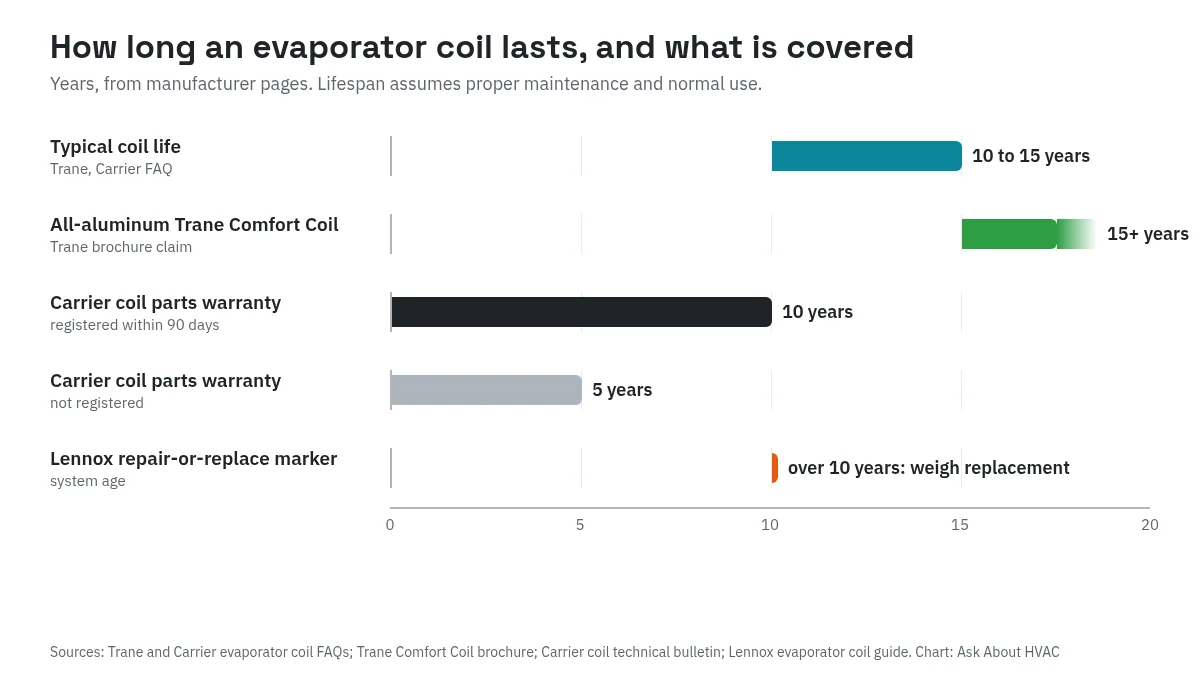
Plan on 10 to 15 years. That is the range both Trane and Carrier give for an evaporator coil with proper maintenance and normal use. The catch is in that phrase "proper maintenance." A coil that sees clean filters, clean air and a correctly charged system can outlast the furnace it sits on. A copper coil in a tight house full of cleaning sprays can spring a pinhole leak within a few years.
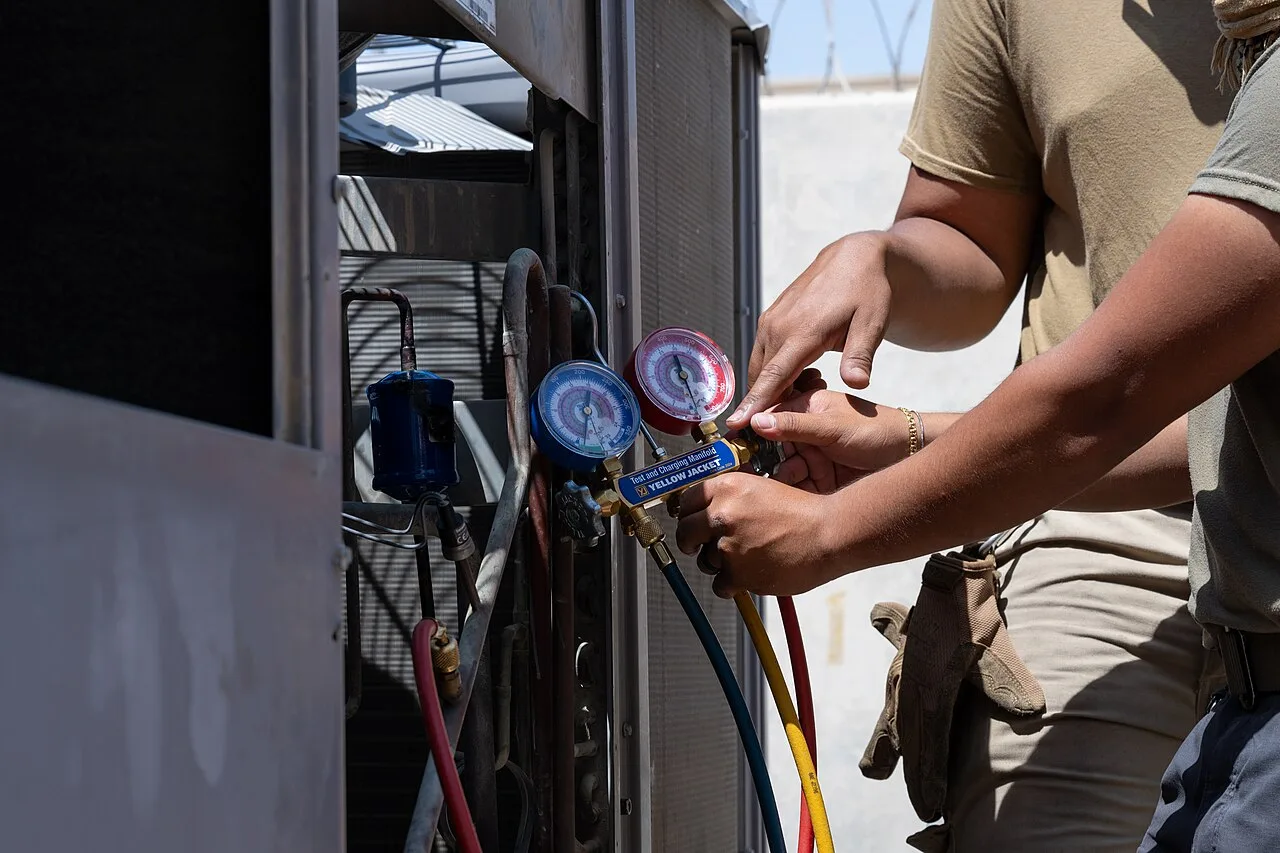
The coil itself is a bundle of refrigerant tubing and thin fins inside the air handler or on top of the furnace. Trane describes it as the indoor half of the refrigeration loop: it works with the condenser coil outside to pull heat and humidity out of your house. It has no motor and almost no moving parts, which is why it usually fails from corrosion, dirt or damage rather than from wearing out.
What shortens a coil's life
Formicary corrosion in copper coils
This is the failure that surprises homeowners, because the coil looks fine right up to the day it leaks. Goodway's coil corrosion explainer lays out the mechanism. Newer homes are built tighter, so chemicals from cleaners, paints and building materials stay indoors and circulate through the air conditioner. When those chemicals, especially chlorides, pass over a copper coil, they mix with condensate on the tube surface and cause pitting and formicary corrosion. The damage forms tiny tunnels under the tube surface that creep through the wall like ant tunnels until refrigerant leaks out. Goodway reports contractors seeing coil failures within just a few years of construction in new homes.
You can't see it starting, and a repair rarely holds because the tunnels run through the whole coil. That is the main reason manufacturers moved to aluminum.
Problem drywall
A related but more extreme case: the Consumer Product Safety Commission has collected about 4,051 reports from residents in 44 states, D.C., American Samoa and Puerto Rico who link health symptoms or metal corrosion to problem drywall. Homeowners report corrosion or blackening of metal on electrical fixtures, appliances, plumbing and air conditioner coils. Most of those homes were built in 2006 and 2007.
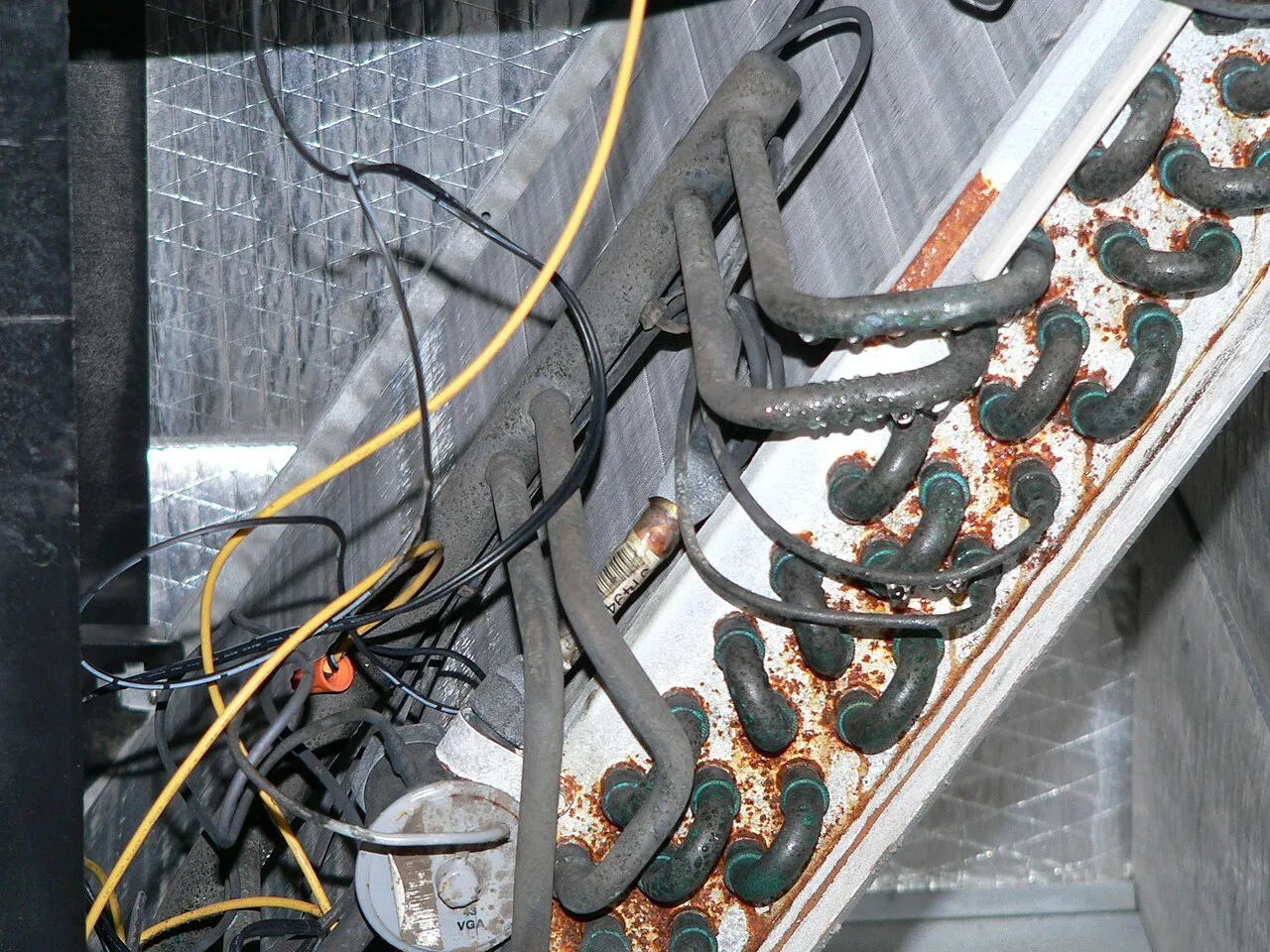
If you live in a 2006 or 2007 build and your coil keeps failing, or you see blackened copper wiring and pipes elsewhere in the house, CPSC's center has the identification steps.
Dirt on the fins
Dust acts as an insulator on the coil, Trane explains, so the system runs longer to reach the thermostat setting. ENERGY STAR's maintenance checklist puts it in plain terms: dirty coils reduce the system's ability to cool your home, make it run longer, raise energy costs and reduce the life of the equipment. A coil that runs longer every summer is also wet longer, which gives those corrosive chemicals more time to work.
The usual source of the dirt is a neglected filter. Trane lists a dirty air filter as the top cause of a frozen coil, and notes that a dirty filter can lead to a dirty coil. Repeated freezing and thawing is not something a coil enjoys either.
Leaks from rubbing and damage
Trane's coil troubleshooting guide mentions leaks that start where refrigerant lines rub together, and from ice pick damage (someone chipping at a frozen coil). Bent fins are another mechanical problem; Trane says if only about 10% of the fins are bent you can straighten them with a fin comb, but more extensive damage is a job for a technician.
Signs your coil is near the end
Lennox lists these as signs you may need a replacement:
- Cooling that comes and goes
- Refrigerant leaks that keep returning after repair
- Unusual noise or odors
- A frozen coil or visible damage
- Significant rust or corrosion
Trane's frozen coil article adds a clue for leak hunting: an oily residue around the indoor coil or a hissing sound near either coil. That calls for a technician right away. If you suspect the system is low on refrigerant, our guide to the signs of an AC refrigerant leak walks through what else to look for, and how long refrigerant should last explains why "it just needs a top-off" is never the whole story.
Warranty first, then repair or replace
Before anyone quotes you a coil, find the installation date and check whether the system was registered. Carrier's coil technical bulletin is a good example of how much this matters: its coils carry a 10-year parts limited warranty for the original owner with timely registration, and the warranty is five years if the system isn't registered within 90 days of installation (except where state law doesn't allow that condition). Labor is a separate question, so ask your contractor what their workmanship coverage was.
Once warranty is settled, Lennox offers a simple rule of thumb: if the system is more than 10 years old, or the repair would cost more than half the price of a new unit, replacement may be the more economical choice. Lennox puts typical coil replacement at roughly $600 to $2,000, depending on the system and its complexity.
Two other points from the same source shape the decision:
- The coil must match the outdoor unit. Lennox warns that a mismatched coil can reduce efficiency and cause long-term damage. On an older system that may limit your choices.
- This is a refrigerant job. EPA Section 608 requires technicians who maintain, service, repair or dispose of equipment that could release ozone-depleting refrigerants to be certified. Recovering the charge and recharging after a coil swap is not a homeowner task.
Our take: on a coil older than about 10 years that has already been patched once, put the money toward the system. On a 4-year-old coil with a fresh leak, the warranty paperwork is worth more than any repair quote.
How to get the full 15 years
Most of what protects a coil happens away from the coil:
- Change the filter on schedule. Trane suggests every 30 to 90 days depending on the filter, how hard the system runs and whether you have pets. If you aren't sure where yours is or how often yours really needs it, here's how to tell when a furnace filter needs changing. A better filter helps too; see choosing an air filter your system can handle.
- Keep return vents clear. Trane points out that a couch over a return vent starves the coil of airflow and can make it freeze.
- Book professional maintenance. ENERGY STAR's checklist includes cleaning both the indoor and outdoor coils as part of a contractor tune-up. Trane advises against DIY coil cleaning and says it could void your warranty.
- Ventilate when you use strong chemicals. Given the corrosion mechanism Goodway describes, running cleaning products, paint and solvents with the windows open keeps less of that vapor passing over a copper coil. This is our inference from that mechanism, not a manufacturer instruction.
- Watch the drain side. A coil that sweats into a clogged pan causes its own damage. If water appears around the furnace in summer, start with why a furnace drips water when the AC is on.
When to call a pro
Call when you see ice on the coil or refrigerant lines, oily spots near the coil, or cooling that fades while the blower keeps running. Trane's troubleshooting guide suggests turning the thermostat off for 1 to 3 hours to let a frozen coil defrost, but if it freezes again, or you see a leak under the indoor unit, it needs a technician. Bring the install date and registration status to that call; it decides whether you are paying for a part or only labor.
FAQ
My coil is 8 years old and leaking. Is it worth repairing?
Check the warranty first. Carrier's coils carry a 10-year parts warranty when registered within 90 days of installation and 5 years when not, so the part itself may still be covered even if labor is not. If the whole system is past 10 years, Lennox suggests replacement often makes more sense, especially when the repair would cost more than half of a new unit.
Can I clean my own evaporator coil?
Trane says no: leave coil cleaning to an HVAC professional, and warns that DIY work beyond changing filters could void your warranty. What you can do safely is change the filter on schedule and keep return vents clear, which keeps dirt off the coil in the first place.
Do aluminum coils really last longer than copper?
They avoid one specific failure. Formicary corrosion attacks copper tubing, and Carrier and Trane both moved to all-aluminum designs marketed for corrosion resistance; Trane's brochure claims an expected service life of more than 15 years for its Comfort Coil. Aluminum does not protect a coil from dirt, physical damage or a poorly matched system.
Will a new coil work with my old outdoor unit?
Only if it is matched to it. Lennox warns that a mismatched coil can reduce efficiency and cause long-term damage, and recommends having a licensed professional confirm compatibility. Refrigerant work on the swap also has to be done by a technician certified under EPA Section 608.
Sources
| # | Source | Site |
|---|---|---|
| 1 | Evaporator Coils (FAQ), Trane | trane.com |
| 2 | Evaporator Coils (FAQ), Carrier | carrier.com |
| 3 | Evaporator Coils technical bulletin (warranty terms), Carrier | econtent.adhq.com |
| 4 | Comfort Coils consumer brochure, Trane | trane.com |
| 5 | Evaporator coil glossary entry, Lennox | lennox.com |
| 6 | Coil Corrosion Causes and Reduction, Goodway | goodway.com |
| 7 | Drywall Information Center, U.S. Consumer Product Safety Commission | cpsc.gov |
| 8 | Maintenance Checklist, ENERGY STAR | energystar.gov |
| 9 | Coils Troubleshooting Guide, Trane | trane.com |
| 10 | Top 5 Causes of Frozen AC Coils, Trane | trane.com |
| 11 | Section 608 Technician Certification, U.S. EPA | epa.gov |
Every number above was checked against these sources. Found an error? See corrections or email contact@askabouthvac.com.

J.T. Bratcher
- License
- TACLB00138638E
- Type
- Texas Air Conditioning and Refrigeration Contractor License (Environmental, Class B)
- Status
- Current · expires April 11, 2027
- Checked
- October 18, 2026 via TDLR All Licenses dataset (data.texas.gov), license 138638
Related answers
- Mt · Maintenance
How Long Does Refrigerant Last in an AC? Why It Shouldn't Run Out
Refrigerant in a home AC isn't used up. A sealed system should hold its charge for its whole life, so low refrigerant means a leak. What to ask your technician, and the 2026 rules for R-22 and R-410A owners.
- Du · Ducts & Airflow
How Long Does Ductwork Last? Why the Age Number Misleads
NAHB's 2007 survey lists ducting at 10 years, yet many duct runs last far longer. Here is why the numbers disagree, what fails first, and how to judge your own ducts.
- Aq · Indoor Air & Humidity
How to Choose an Air Filter for Your Home: Size, MERV and What Your System Can Handle
Match the exact size on your old filter, then pick the highest MERV your fan and slot can take, often MERV 13. What EPA, DOE and Berkeley Lab data say about airflow, ozone and purifiers.