How Long Do HVAC Systems Last? The Numbers, and What They Measure
| Written by | Ask About HVAC Editorial Team | Expert review | ✓ J.T. Bratcher |
|---|---|---|---|
| Published | Last reviewed | ||
| Sources | 7 cited | Reading time | 7 min |
Quick answer
A central air conditioner averages about 15 years, a heat pump 16, a gas furnace 18, an oil furnace 20 and a gas boiler 21. Those are the industry figures that the National Association of Home Builders reprinted in its 2007 life expectancy study, and they are where most of the lifespan ranges you see online trace back to. The same study sums it up plainly: even in the best case, most HVAC components last 15 to 25 years.
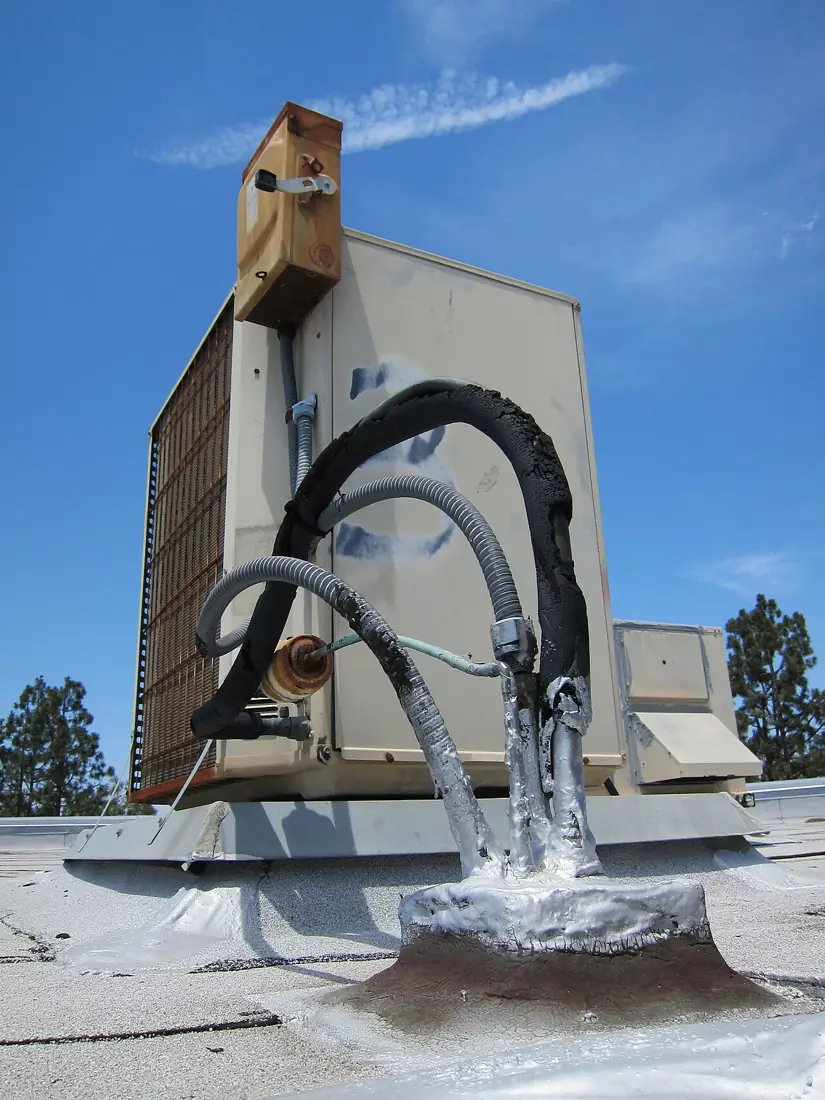
Two things those numbers do not tell you are when your own system will fail and when it makes sense to replace it. Those are separate questions, and the rest of this page takes them one at a time.
The published lifespan numbers
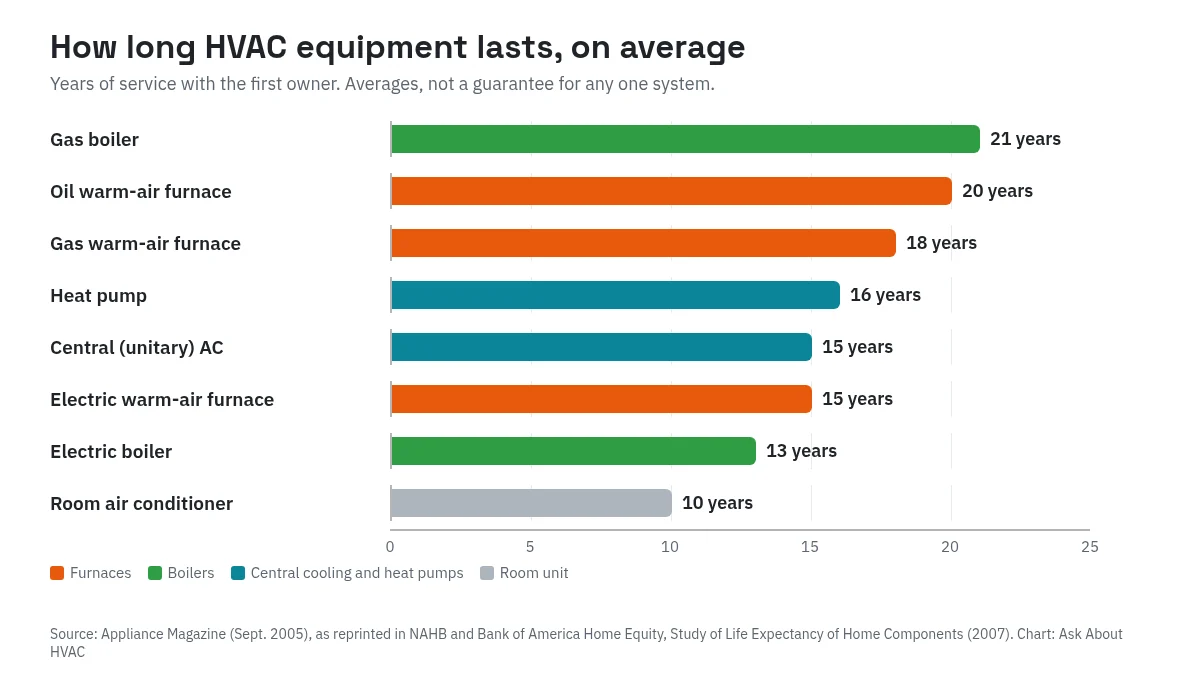
The NAHB report contains two HVAC tables. The first, compiled from manufacturer and trade association figures, lists furnaces at 15 to 20 years, heat pumps at 16, air conditioners at 10 to 15, boilers at 13 to 21 and thermostats at 35. The second breaks equipment down by fuel, using figures from the September 2005 issue of Appliance Magazine:
| Equipment | Average life (years) |
|---|---|
| Gas boiler | 21 |
| Oil warm-air furnace | 20 |
| Gas warm-air furnace | 18 |
| Heat pump | 16 |
| Central (unitary) air conditioner | 15 |
| Electric warm-air furnace | 15 |
| Electric boiler | 13 |
| Room air conditioner | 10 |
| Dehumidifier | 8 |
What "first-owner use" means
The fine print under that second table matters. It says the life expectancy is based on first-owner use. In plain terms, the figure tracks how long equipment stays in service with its original owner, which is not the same as the day the compressor or heat exchanger quits. Some units are swapped out while they still run, during a remodel or a home sale, and some keep running well past the average.
So one house can have a furnace running well past 20 years while the house next door replaces a condenser before 10. Treat the averages as a planning number for budgeting, not a countdown.
Geothermal: two very different clocks
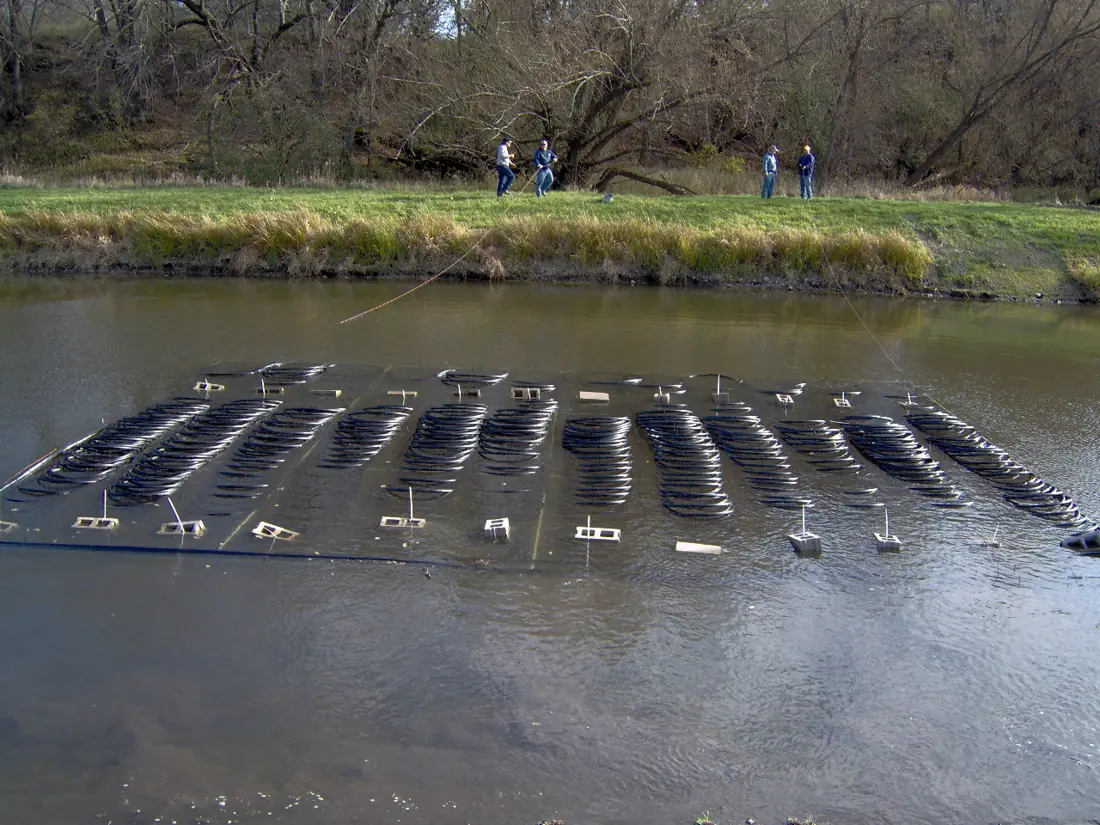
Ground-source heat pumps split into two parts with different lifespans. A U.S. Department of Energy geothermal heat pump handout estimates system life at 25 years for the inside components and 50 years or more for the ground loop. The same handout says that, compared with air-source heat pumps, they are quieter, last longer and need little maintenance, and they do not depend on the temperature of the outside air.
Lifespan is not the same as "time to replace"
ENERGY STAR's replacement guidance suggests talking to a contractor when a heat pump or air conditioner is more than 10 years old, or a furnace or boiler is more than 15. Those ages sit well below the averages above, and that is deliberate. The trigger is efficiency and comfort, not imminent failure. ENERGY STAR says correctly installed certified heat pumps and air conditioners can save up to 20 percent on heating and cooling costs, and that a certified furnace is 15 percent more efficient than a conventional one.
The same page lists the other signs that a system has slipped, whatever its age:
- It needs frequent repairs and your energy bills are going up.
- Some rooms are too hot or too cold.
- The house has humidity problems, too dry in winter or too humid in summer.
- There is excessive dust, which can come from leaky ducts pulling air from attics and crawl spaces.
- The system is noisy, which can point to an undersized duct system or a problem with the indoor coil.
ENERGY STAR's main heating and cooling page puts the 10-year mark more gently: if equipment is more than 10 years old or not keeping the house comfortable, have a professional HVAC contractor evaluate it. That is the honest reading. Ten years means "get it looked at," not "start shopping."
What shortens an HVAC system's life
Federal efficiency guidance names specific faults that cut equipment life short. Most of them start on installation day.
Sizing, airflow and charge at installation
ENERGY STAR's quality installation page warns that oversized equipment may cycle too frequently, resulting in less comfort and a shortened lifespan, and that poor system airflow can also shorten equipment life. It asks contractors to size from the home's actual characteristics instead of a rule of thumb, to set airflow to the manufacturer's specifications, and to test and adjust refrigerant charge. Elsewhere ENERGY STAR estimates improper installation can reduce system efficiency by up to 30 percent and possibly shorten the equipment's life.
If you are choosing a new system now, sizing is the one decision you cannot fix later. Our explainer on what size central air unit you need walks through why tonnage should come from a load calculation.
Maintenance faults the checklist names
ENERGY STAR's maintenance checklist is unusually direct about which neglected items reduce equipment life:
- Loose electrical connections. Faulty connections can cause unsafe operation and reduce the life of major components.
- Dirty coils. Dirty evaporator and condenser coils make the system run longer, raising energy costs and reducing equipment life. Our guide to how long evaporator coils last covers the corrosion side of coil failure.
- Wrong refrigerant charge. Too much or too little refrigerant makes the system less efficient and reduces its life. A system that keeps needing a top-off has a leak, which our page on how long refrigerant lasts in an AC explains.
- Dirty filters. The main heating and cooling page says a clean filter keeps dust and dirt from building up in the system, which can otherwise lead to expensive maintenance or early system failure. It recommends checking the filter every month and changing it at least every 3 months.
The checklist schedules the cooling check-up in spring and the heating check-up in fall, because contractors get busy once summer and winter arrive. On a furnace, that visit should include the gas connections, burner and heat exchanger. ENERGY STAR notes a dirty burner or cracked heat exchanger causes improper burner operation, which is a safety issue as much as a lifespan one. If you smell gas or a carbon monoxide alarm sounds, get everyone outside first and then call a licensed pro or your gas utility.
Older R-22 systems
Older central air conditioners and heat pumps may run on HCFC-22, often called R-22, and EPA says you can no longer buy a new central AC unit that uses it. EPA's homeowner FAQ on the phaseout is clear that you are not required to replace working equipment. As of January 1, 2020, no new HCFC-22 is made or imported into the United States, but reclaimed refrigerant cleaned to new specifications is still available for servicing existing systems.
EPA also says there are no "drop in" replacements for HCFC-22, and it asks homeowners to have technicians find and repair leaks instead of topping off a leaking system. Use a technician with EPA Section 608 certification, which is required to service this equipment. In practice, an R-22 system that needs a major refrigerant repair late in its life is often where a replacement quote starts to make sense.
How to judge your own system
- Find the age. Look for a manufacture date on the data plate of the outdoor unit and the furnace. If there is only a serial number, the manufacturer's customer service can usually tell you the build date, and an installer's invoice or home inspection report may list it too.
- Compare it with the averages. Use the table above for your equipment type and fuel, and the ENERGY STAR ages of 10 years for heat pumps and air conditioners and 15 for furnaces and boilers.
- Look at the signs, not just the age. Rising bills, uneven rooms, humidity trouble, dust and noise are the symptoms ENERGY STAR lists.
- Get a real evaluation. Ask the contractor to check electrical connections, coils, refrigerant charge, airflow and, on a furnace, the heat exchanger. If repairs keep coming, ask for a replacement quote at the same visit.
- Plan the replacement before it is urgent. Shopping during a heat wave or a cold snap limits your choices, which is the same reason ENERGY STAR times check-ups for spring and fall. If you are comparing efficiency levels, our guide to what counts as a good SEER rating explains the current minimums, and the same visit is a sensible time to ask how much life your ductwork has left.
If a heat pump is struggling rather than dying, start with the checks in why your heat pump is not working before assuming the age is the problem.
The short version
Expect roughly 15 to 20 years from most central HVAC equipment, a little less from room units and electric heat, and more from gas boilers and geothermal ground loops. Ten years on a heat pump or AC, or fifteen on a furnace or boiler, is the point to have it evaluated, not the point it fails. What decides whether your system beats the average is mostly the installation and the yearly maintenance.
FAQ
Is a 20-year-old furnace living on borrowed time?
It is past the averages. The industry table NAHB published lists gas warm-air furnaces at 18 years and oil furnaces at 20, and ENERGY STAR suggests considering replacement once a furnace or boiler passes 15. Age alone does not mean it is unsafe, but a furnace that old should get a yearly check of the burner and heat exchanger, since ENERGY STAR notes a cracked heat exchanger causes improper burner operation.
Do heat pumps wear out faster than air conditioners?
The published averages are close: 16 years for heat pumps and 15 for unitary central air conditioners in the Appliance Magazine figures NAHB reprinted. A heat pump does both jobs, so it runs in winter and summer, and ENERGY STAR flags both heat pumps and air conditioners for evaluation after 10 years.
Should I replace a working R-22 air conditioner just because of the refrigerant?
EPA says you are not required to. No new HCFC-22 has been made or imported since January 1, 2020, but reclaimed R-22 is still sold for servicing existing systems. The cost of that refrigerant and the age of the unit are what push the decision, so ask for a leak repair quote and a replacement quote side by side.
Which part of a geothermal system lasts longest?
The buried or submerged ground loop. A U.S. Department of Energy handout estimates 25 years for the inside components and 50 years or more for the ground loop, so a worn-out geothermal heat pump can usually be replaced without redrilling.
Sources
| # | Source | Site |
|---|---|---|
| 1 | Study of Life Expectancy of Home Components, NAHB and Bank of America Home Equity (2007) | reservedataanalyst.com |
| 2 | When Is It Time to Replace?, ENERGY STAR | energystar.gov |
| 3 | Heat and Cool Efficiently, ENERGY STAR | energystar.gov |
| 4 | HVAC Quality Installation, ENERGY STAR | energystar.gov |
| 5 | Maintenance Checklist, ENERGY STAR | energystar.gov |
| 6 | Geothermal Ground-Source Heat Pump handout, U.S. Department of Energy | energy.gov |
| 7 | Homeowners and Consumers: Frequently Asked Questions (HCFC-22), U.S. EPA | epa.gov |
Every number above was checked against these sources. Found an error? See corrections or email contact@askabouthvac.com.

J.T. Bratcher
- License
- TACLB00138638E
- Type
- Texas Air Conditioning and Refrigeration Contractor License (Environmental, Class B)
- Status
- Current · expires April 11, 2027
- Checked
- October 18, 2026 via TDLR All Licenses dataset (data.texas.gov), license 138638
Related answers
- Mt · Maintenance
How Long Do Evaporator Coils Last? What Decides 15 Years vs 5
Trane and Carrier both put evaporator coil life at 10 to 15 years. Here is what shortens it (corrosion, dirt, leaks), how warranty registration changes the math, and when to replace.
- Mt · Maintenance
How Long Does Refrigerant Last in an AC? Why It Shouldn't Run Out
Refrigerant in a home AC isn't used up. A sealed system should hold its charge for its whole life, so low refrigerant means a leak. What to ask your technician, and the 2026 rules for R-22 and R-410A owners.
- Sf · Safety & Emergencies
Why Do My Air Ducts Smell Musty? Find the Moisture First
A musty smell from the vents almost always points to moisture: a wet coil or drain pan, damp duct insulation, or ducts sweating in an attic or crawl space. How to find it, and what EPA says about fixing it.